Reviewed by: Enerzip Power Technology (Weifang) Co., Ltd. – Applications & Integration Team
Last updated: 02-Feb-2026
Disclaimer: This article is an engineering interpretation using ISO 8528 generator ratings terminology and common industry practice. It is not the official ISO standard text. For compliance and contractual definitions, refer to the applicable ISO standard edition and the generator manufacturer’s documentation.
Summary: ISO 8528 generator ratings and real duty cycle definitions are the difference between a generator that performs as expected and one that becomes a dispute. This guide explains ESP vs LTP vs PRP vs COP, how to map operating hours and load profiles into RFQ language, and how to avoid common rating and derating misunderstandings in EPC projects.
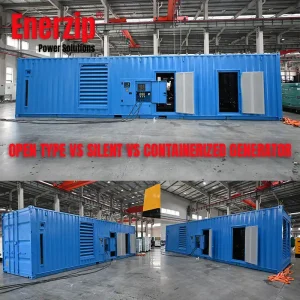
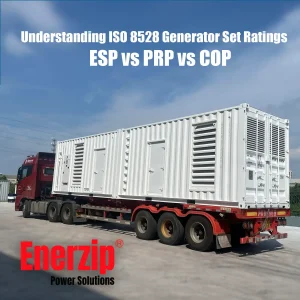
Image requirement (for SEO): Insert a real project photo showing intake-discharge layout (genset room / silent canopy / container).
Recommended ALT text (copy/paste): ISO 8528 generator ratings intake and discharge layout in high ambient enclosure
ISO 8528 generator ratings: what ISO 8528 defines (and what it doesn’t)
In generator projects, “rating” is often treated as a marketing number. In reality, ISO 8528 generator ratings exist to make sure everyone uses the same engineering language: what operating duty a genset is designed for, under defined reference conditions, with defined performance expectations. For the official framework behind application, ratings, and performance terminology, readers may also review ISO 8528-1.
Important: ISO terminology does not replace project engineering. Final selection must still be validated against:
- Load profile (steady totals + worst-case transients)
- Motor starting and step-load behavior
- Site environment (temperature, altitude, ventilation constraints)
- Control scope (ATS, load shedding, paralleling, synchronization)
- Fuel quality constraints (especially natural gas / biogas)
Why ratings matter more than nameplate kVA
Two generator sets with the same kVA nameplate can behave very differently in real operation. Correct ISO 8528 generator ratings selection impacts:
- Allowed annual operating hours and maintenance assumptions
- Thermal margin for sustained load and hot sites
- Transient capability under load steps and motor starting
- Commercial risk: disputes when the genset runs outside intended duty
Enerzip Field Note: Most “oversizing” is not because customers want extra power. It happens because duty cycle and load pickup behavior are unclear. Once start sequence and site conditions are clarified, many projects can reduce size or improve stability without paying for unnecessary kVA.
ESP — Emergency Standby Power
ESP (Emergency Standby Power) is intended for emergency use during utility outages. It is typically specified when:
- The generator runs only when the utility fails
- The load is variable
- Annual run hours are limited (define explicitly in contract/spec)
Where ESP fits best
- Hospitals, commercial buildings, public utilities (backup only)
- Data centers that are truly “emergency-only” + periodic tests
- Industrial plants with stable utility and outage protection needs
Where ESP is often misused
- Unreliable grid regions where the genset runs frequently
- Remote sites where gensets run daily or for long periods
- Load growth pushes the unit toward sustained high load
LTP — Limited-Time Running Power
LTP (Limited-Time Running Power) is used when a genset may supply power for a limited time per year under specified conditions. In EPC RFQs, LTP is helpful when the site is not “prime” year-round but still needs a defined limited-duration operating envelope that is more explicit than ESP.
- Use LTP when operating duration is limited but clearly defined
- Always state allowed annual hours and load behavior in your RFQ
- Confirm exact LTP meaning in the applicable ISO edition and OEM rating sheet
PRP — Prime Rated Power
PRP (Prime Rated Power) is intended for applications where the generator is a primary source of power, or where the grid is unreliable. It is typically specified when:
- The genset supplies power for long periods
- Load is variable
- Operating hours may be high (define expectations in project specs)
Where PRP fits best
- Construction sites, mines, remote industrial facilities
- Plants in regions with unstable utility supply
- Temporary or rental power projects with variable demand
Note: PRP is often the correct rating when a generator is “backup in theory” but “daily power in reality.” Correct ISO 8528 generator ratings selection reduces warranty and performance disputes.
COP — Continuous Power
COP (Continuous Power) is intended for applications with constant or near-constant load and extended run time. It is typically specified when:
- The genset runs continuously as a primary power source
- Load is relatively stable
- Thermal and mechanical margins support long-duration operation
ISO 8528 generator ratings comparison: ESP vs PRP vs COP vs LTP
| Rating | Typical use | Load behavior | Project risk if misused |
|---|---|---|---|
| ESP | Emergency backup only (utility outages) | Variable; limited annual hours (define in contract) | High: becomes frequent/long operation without design intent |
| LTP | Limited-time annual operation envelope | Variable; limited duration under defined conditions | High: disputes if annual hours/limits are not explicit |
| PRP | Primary power or unreliable grid | Variable; high operating hours expected | Medium: risk if treated like base-load without scope |
| COP | Continuous/base-load operation | Stable; extended run time | Medium: risk if transients are ignored in design |
How to choose the correct rating for your project
Step 1 — Define the real duty cycle (not the sales description)
- Expected operating hours per day / per year
- Typical load range (minimum, average, peak)
- Seasonality and future expansion expectations
- Downtime tolerance: can you accept a single point of failure?
Step 2 — Align ISO 8528 generator ratings to how the genset will actually run
- Outages only + periodic tests → ESP is usually appropriate
- Frequent runtime due to grid instability → PRP is usually safer
- Base-load or near base-load → COP is typically required
- Limited operation beyond emergency-only but defined annual limits → consider LTP
Load profile: the missing link between ratings and real performance
ISO 8528 generator ratings do not replace the need for a load profile. A complete RFQ should include:
1) Steady running totals
- Running kW and kVA at normal operation
- Power factor (PF) assumptions
- Non-linear loads (UPS/rectifiers) and harmonic expectations
2) Worst-case transient events
- Largest motor start and start method
- Simultaneous load pickup at transfer (ATS behavior)
- Re-acceleration after transfer (motor decel + restart)
- Instantaneous step loads from electronic systems
Derating: temperature, altitude, enclosure and fuel
Definition (for RFQ clarity): In this guide, “derating” means any reduction in available output or operating margin due to site conditions (temperature/altitude/airflow/fuel), including protective power limitation or shutdown behavior depending on controller logic. For general reference on engine power declaration under stated reference conditions, readers may also review ISO 3046-1.
- High ambient (40–50°C): reduced cooling margin; canopy/container airflow can reduce real capability
- Altitude: reduced air density impacts engine output and cooling effectiveness
- Enclosure integration: intake/outlet positioning and pressure drop matter; recirculation can reduce usable capacity
- Fuel: gas/biogas supply quality and stability can become a performance limiter
RFQ wording you can copy/paste (EPC-ready)
The wording below includes practical, “industry-realistic” default numbers to reduce ambiguity. Replace them if your project requires different values.
Option A — ESP (Emergency Standby Power)
The generator set shall be offered under ISO 8528 generator ratings terminology. The required rating category is ESP. Expected operating hours are ≤ 200 hours/year (including testing) with variable load between 30% and 80% of rated kW. The load profile includes motor starting and step loads as specified in the attached load list. Site conditions: ambient 45°C typical / 50°C peak, altitude 1000 m, installation outdoor, enclosure type silent canopy or container. Control scope includes ATS + load shedding + remote monitoring. Final sizing shall be validated against transient performance and site derating, and must reference OEM rating sheets for stated limits.
Option B — LTP (Limited-Time Running Power)
The generator set shall be offered under ISO 8528 generator ratings terminology. The required rating category is LTP. Expected operating hours are ≤ 500 hours/year with variable load between 30% and 90% of rated kW. The load profile includes motor starting and step loads as specified in the attached load list. Site conditions: ambient 45°C typical / 50°C peak, altitude 1000 m, installation outdoor, enclosure type silent canopy or container. Control scope includes ATS + load shedding + remote monitoring. Final sizing shall be validated against transient performance and site derating, and must reference OEM rating sheets for stated limits.
Option C — PRP (Prime Rated Power)
The generator set shall be offered under ISO 8528 generator ratings terminology. The required rating category is PRP. Expected operating hours are 3000 hours/year with variable load between 30% and 90% of rated kW. The load profile includes motor starting and step loads as specified in the attached load list. Site conditions: ambient 45°C typical / 50°C peak, altitude 1000 m, installation outdoor, enclosure type silent canopy or container. Control scope includes ATS + load shedding + remote monitoring (paralleling optional if specified). Final sizing shall be validated against transient performance and site derating, and must reference OEM rating sheets for stated limits.
Option D — COP (Continuous Power)
The generator set shall be offered under ISO 8528 generator ratings terminology. The required rating category is COP. Expected operating hours are 8000 hours/year with near-constant load between 70% and 100% of rated kW. The load profile includes motor starting and step loads as specified in the attached load list. Site conditions: ambient 45°C typical / 50°C peak, altitude 1000 m, installation outdoor, enclosure type containerized power house. Control scope includes load management + remote monitoring (ATS if applicable; paralleling if required by redundancy). Final sizing shall be validated against transient performance and site derating, and must reference OEM rating sheets for stated limits.
RFQ selection rule (prevents supplier self-selection): Supplier shall quote strictly to the rating category specified by the Buyer (ESP/LTP/PRP/COP). If the Supplier recommends a different rating category, the Supplier shall provide written justification based on operating hours, load profile, and site derating assumptions.
Common mistakes that create disputes
- Calling the project “standby” while running the genset daily
- Providing only total kW without motor starting and step-load details
- Not defining ATS transfer behavior and load pickup sequence
- Ignoring enclosure airflow/ventilation in high ambient regions
- Mixing rating terms without stating annual hours and duty
FAQ
1) Is ISO 8528 the same as the official nameplate rating?
ISO terminology helps define rating categories and test language. The actual nameplate rating and limits are defined by the manufacturer’s documentation and the project contract scope.
2) If my genset is “backup,” should I always choose ESP?
Not always. If the grid is unreliable and the genset runs frequently, PRP may be more appropriate. If operation exceeds emergency-only but stays within defined annual-hour limits, LTP can be used—confirm exact limits in the applicable ISO edition and OEM sheet.
3) What matters more: rating category or kVA size?
Both. ISO 8528 generator ratings define duty intent; kVA size must still be validated for load profile, motor starting, step loads, and site derating.
4) Why do some projects fail even when the genset is bigger than required?
Failures often happen during transient events (start/step loads) and harsh site conditions (heat/airflow). Stability is a system integration outcome, not only a nameplate number.
Next step
If you share your load list (Excel), duty intent (backup vs frequent operation), site conditions (temperature/altitude), and control scope (ATS/load shedding/paralleling), Enerzip can translate requirements into an actionable configuration: rating category, sizing range, start sequence strategy, and system integration scope aligned to ISO 8528 generator ratings and OEM limits.
Related Enerzip resources
- Generator Specification Checklist for EPC Projects
- Genset Factory Testing (FAT) & Inspection Steps + Warranty Support
- Diesel Generator Sets
- Natural Gas Generator Sets
- Biogas Generator Sets
- Automatic Transfer Switches (ATS)