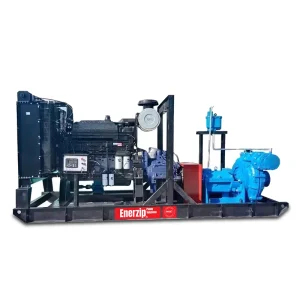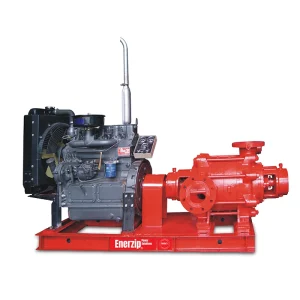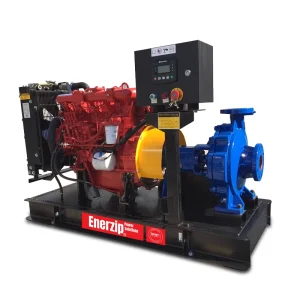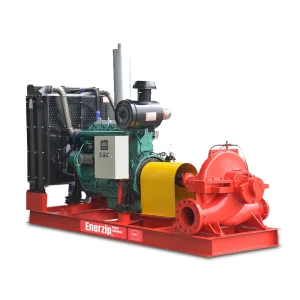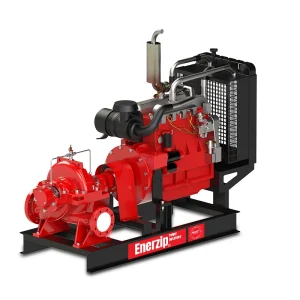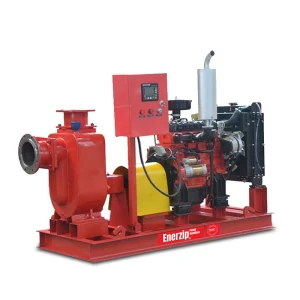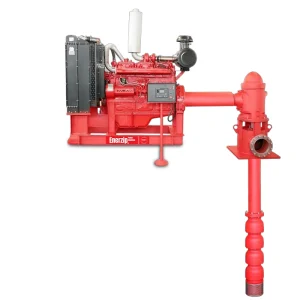

Diesel-powered water pumps are suitable for situations where there is no electricity on site, the power grid is unstable, or electric pumps are unsuitable. They are commonly used for flood prevention and drainage, construction dewatering, agricultural irrigation, mine drainage, industrial water supply, emergency bypass pumping and off-grid water supply.
Enerzip supplies complete diesel-driven water pump systems, configured to suit specific site conditions. Selection typically requires consideration of flow rate, total head, suction lift, water quality, solids content, operating time, ambient temperature, altitude and installation method.
Depending on the pump model, Enerzip can match Cummins, Perkins, Deutz or Weichai diesel engines, as well as DSE, ComAp, DEIF or SmartGen controllers. Start-up, cooling, exhaust, base, protection and monitoring configurations are selected according to the pump’s operating conditions and site requirements.
Features:
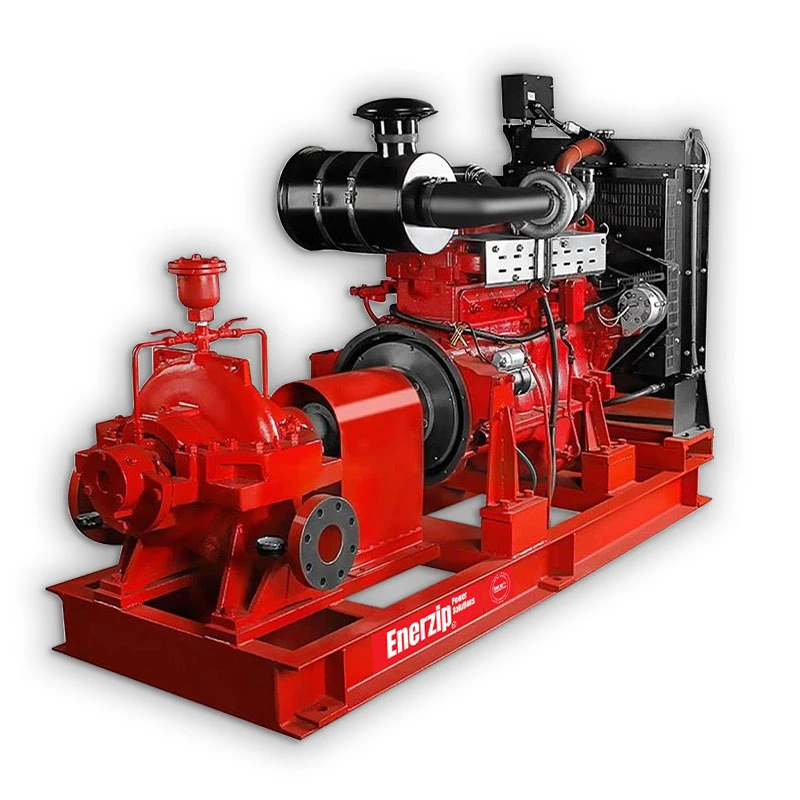
Enerzip diesel-driven water pumps are categorised according to actual pumping conditions, including emergency drainage, high-flow delivery, low-head flood prevention and drainage, high-head pressure boosting, slurry conveyance and deep-well water extraction.
Selecting the appropriate pump requires more than just considering the bore size. Flow rate, total head, suction lift conditions, water quality, solids content, operating time and site conditions all influence the final configuration. An unsuitable pump model may result in loss of self-priming, cavitation, blockages, overheating, accelerated wear or diesel engine overload.
Before finalising a solution, Enerzip checks the basic pump data: flow rate, head, fluid type, suction lift conditions, operating hours and site information. A clear understanding of the operating conditions helps to minimise errors in pump or motor selection.
Skid-mounted layouts, trailer configurations, lifting points, fuel tank positions, piping connection orientations and maintenance access can all be adjusted to suit site conditions. Photographs, drawings or simple sketches can help to confirm these details more quickly.
Prior to dispatch, Enerzip checks engine start-up, controller functionality, coupling alignment, cooling layout, exhaust installation, safety signals and basic operational status.
Enerzip provides post-delivery support for installation issues, commissioning coordination, controller settings, operational queries and troubleshooting, particularly for remote sites or long-duration pumping operations.
Diesel-powered water pumps are suitable for sites where the power grid is unreliable, there is no stable power supply, or where mobile pump units are more convenient to deploy than electric pump systems. When selecting a pump, one must not consider only the inlet and outlet diameters. Flow rate, total head, suction lift, medium, operating time and site layout all influence the final configuration.
Clean water conveyance, slurry drainage, sewage bypass, slurry transport, mine dewatering and deep well water supply all require different pump configurations. Pumps used for short-term emergency drainage will not be configured in exactly the same way as those used for routine, long-term irrigation or industrial cooling.
Suction lift is one of the first details that needs to be confirmed. Fluctuations in water level, long suction pipes, air ingress and the need for repeated priming can all affect on-site operation. Where suction conditions are unstable, self-priming pumps are usually the more practical choice.
Flow rate and head must be verified together. Selecting a pump that is too large may increase fuel consumption and cause the pump to operate outside its efficient range. Selecting a pump that is too small may result in insufficient discharge, overheating or overloading of the diesel engine. Long-distance pipework, changes in terrain elevation and variations in discharge distance all affect the total head.
For slurry, sewage, sand, tailings or sludge, information regarding the medium is crucial. Solid content, particle size, abrasiveness, corrosion risk and expected wear should be confirmed before selecting the pump configuration, speed and lining material.
The Enerzip range of diesel-driven pumps includes:
EZ-SP Series – Diesel Self-Priming Pumps — For emergency drainage, sewage bypass, construction dewatering, and temporary pumping applications requiring rapid deployment and self-priming capability.
EZ-DS Series – Diesel Engine Double Suction Pumps — For high-flow water transfer, municipal pumping, flood control and drainage, irrigation, and industrial recirculation.
EZ-SC Series – Diesel Engine Horizontal Split Case Pumps — For high-flow delivery, municipal drainage, industrial cooling, long-distance water conveyance and firefighting standby.
EZ-MF Series – Diesel Drive Mixed Flow Pumps — For low-head, high-flow drainage, canal replenishment, raw water conveyance, irrigation drainage and flood control pumping.
EZ-MS Series – Diesel Engine Multistage Pumps — For high-head boosting, mine dewatering, municipal pressure boosting, RO feedwater, high-pressure cleaning and water supply in mountainous areas.
EZ-SL Series – Heavy-Duty Diesel Engine Slurry Pumps — For tailings, dredging, sand extraction, FGD/ash slurry, steel mill slag flushing and sludge conveyance.
EZ-DW Series – Diesel Engine Driven Deep Well / Vertical Turbine Pumps — For boreholes, deep groundwater extraction, off-grid irrigation, mine water supply, rural water supply and exploration stations.
For applications involving suction head, long suction pipes, high altitudes, warm water or unstable inlet conditions, NPSH and cavitation issues should also be verified when requesting a quotation.
Prior to production, Enerzip will verify the operating point, suction head conditions, medium, operating time, engine power margin, service factor, cooling requirements, control method and overall layout. The aim is to avoid situations where a pump set appears suitable on paper but fails to operate effectively once installed on site.
To avoid under- or over-engineering, we size the set based on your duty point (flow + TDH) and operating mode.
Duty point: flow (m³/h) + TDH (m), and whether it varies
Medium: clean / muddy / sewage / slurry (solids %, particle size, abrasiveness/corrosion)
Suction: suction lift, line length/diameter, water level variation (NPSH if known)
Operating mode: hours/day, 24/7 or emergency standby
Enerzip diesel-powered water pumps are suitable for pumping operations where the mains power supply is unavailable, unstable, or difficult to access on-site. Common applications include flood drainage, temporary bypass pumping, agricultural irrigation, mine dewatering, industrial circulating water systems, slurry conveyance and remote water supply.
Flood control and drainage operations often involve fluctuating water levels, debris, limited deployment time, and sometimes a lack of available power on site.
Typical scenarios include flooded roads, underpasses, underground station entrances, low-lying areas, stormwater outlets and temporary municipal pumping stations. Pumps need to be portable, quick to start up, and capable of operating under unstable suction conditions.
For high-flow flood drainage, the primary requirement is usually the conveyance of large volumes of water at low head. Fixed or semi-fixed drainage stations may utilise pump sets with higher flow rates and easier maintenance.
Diesel-powered pumps are used on construction sites for excavation pit drainage, cofferdam drainage, trench dewatering, sewage bypass, pipeline maintenance and temporary bypass pumping.
Within a single project, pumps may need to be relocated multiple times. Water levels can fluctuate throughout the day, and suction pipes may not remain fully submerged at all times. Sewage bypass operations may also involve solid or fibrous contaminants, or require prolonged operation.
In such operating conditions, hose connections, dry-run protection, maintenance access and site layout are often more critical than the pump’s nominal diameter alone.
Diesel-powered pumps can be used for river water intake, canal replenishment, off-grid irrigation schemes, remote farms and seasonal pumping.
During the irrigation season, pumps may operate for long periods each day. Fuel consumption, cooling capacity, ease of operation and on-site maintenance become practical considerations.
Low-head canal replenishment requires high-flow delivery. Groundwater irrigation may require deep-well pumps or vertical turbine pump configurations.
Mines and quarries utilise diesel-powered pumps to manage open-pit mines, underground tunnels, stormwater accumulation, remote collection pits and long-distance drainage pipelines.
These sites may be subject to dust, vibration, fluctuating water levels and abrasive particles. Some applications require high head to lift water out of mine pits; others require high-flow transfer within the site.
If the water contains mineral fines, sand or tailings, the pump should be selected for abrasive media applications rather than for clean water applications.
Refineries, power stations, steelworks, chemical plants, industrial estates and process plants may utilise diesel-driven pumps for emergency cooling standby, industrial service water supply, process recirculation, or as temporary bypass pumps during maintenance.
These applications require stable flow rates, sufficient cooling capacity for the diesel engine, and clear alarm or monitoring signals to enable operators to assess operational status.
Where required by the project, signal outputs may be provided for integration with PLCs, SCADA systems or BMS.
Deep well and remote water supply projects include drilled wells, tube wells, rural water supply, desert irrigation wells, mine water supply wells and exploration camps.
These sites are typically located far from a reliable mains power supply. Pumps are required to draw water from locations exceeding the actual suction head range of surface pumps and to operate continuously in outdoor environments.
Requirements regarding surface maintenance space, fuel planning and extended operating periods should be confirmed prior to final configuration.
Slurry pumps are used for tailings conveyance, dredging, sand extraction, FGD/ash slurry, steel plant slag flushing, and the conveyance of municipal and industrial sludge.
These operating conditions differ from those of clean water pumping. Solid content, particle size, abrasiveness, corrosion risk and expected wear rates all influence pump design, lining materials, rotational speed and motor power.
For long-term slurry conveyance applications, overload protection and blockage monitoring should be confirmed prior to production.
Seawater differs from ordinary fresh water. For prolonged operation in seawater conditions, the pump requires corrosion-resistant flow components, suitable seals, stainless steel fasteners, protective coatings, and anti-corrosion treatment for skid-mounted bases or trailer frames.
The configuration will not be exactly the same if the pump is used for short-term emergency drainage at the seaside or for the long-term conveyance of seawater. Operating duration, site location, and whether the pump unit is for fixed installation or mobile use should all be confirmed prior to selection.
When the suction head approaches the actual suction head limit of a surface-mounted pump, problems may arise rapidly: insufficient flow, vibration, loss of self-priming, or cavitation.
Longer suction pipes, smaller pipe diameters, air ingress, warm water, high altitudes, or clogged strainers can all worsen suction conditions. If the depth exceeds the specified limit, consider deep well/vertical turbine pumps or alternative configurations.
The lining material for slurry pumps is determined by the slurry itself. For sharp mineral particles, sand, tailings and highly abrasive conditions, high-chromium alloys such as Cr27 are typically considered. For certain fine-particle slurries, or applications with different impact patterns, rubber linings may be more suitable.
When seeking a solution, please provide the solids content, particle size, slurry density, abrasiveness, corrosion risk, flow rate, head and operating time.
Dry running issues can be addressed via the controller, though this is not the only solution. The pump unit can be configured with pressure monitoring, temperature monitoring, low-flow or no-flow alarms, dry-running shutdown logic, and a safety shutdown signal output via the controller.
During on-site installation, the suction pipe must be sealed, the inlet must remain below the water level, and the strainer must be kept clear. Protective logic can mitigate risks, but poor suction installation may still damage the pump.
High altitude reduces the available power of the diesel engine, whilst high ambient temperatures make cooling more difficult.
If these conditions are overlooked, the pump unit may fail to achieve the expected flow rate and head, or the engine operating temperature may exceed planned values. For sites in mining areas, deserts, tropical regions and high-altitude locations, Enerzip will verify the engine power margin, radiator capacity, ventilation conditions, fuel system layout and operating hours prior to confirming the pump unit.
Total head cannot be simply defined by vertical height; it includes suction lift, discharge height, friction losses in the pipework, hose length, pipe diameter, bends, valves, fittings, and the required discharge pressure.
For a quick calculation of total head, please provide the suction lift, discharge distance, pipe or hose dimensions, elevation difference, required flow rate and discharge pressure. A simple sketch or site photograph is usually sufficient to avoid miscalculating the head.