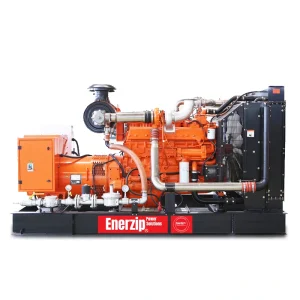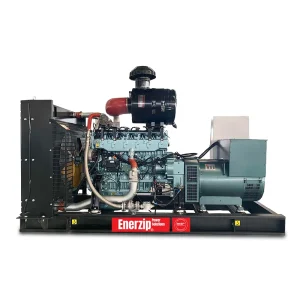

Biogas power generation units utilise gas produced from organic waste to generate electricity, and are suitable for farms, sewage treatment plants, landfill sites, food processing plants and other waste-to-energy projects. Biogas differs from natural gas. Its methane content, pressure, moisture content, H₂S content, condensate and impurity levels vary depending on the specific project site. Before selecting a power generation unit, the gas quality and operating conditions must be confirmed.
Enerzip offers two ranges of biogas generator sets. The E Series is suitable for farm-scale and distributed biogas projects, with a focus on simple operation and easy maintenance. The C Series is designed for industrial-scale biogas projects, ideal for applications requiring extended running times, CHP heat recovery, grid connection or multi-unit systems.
Features:
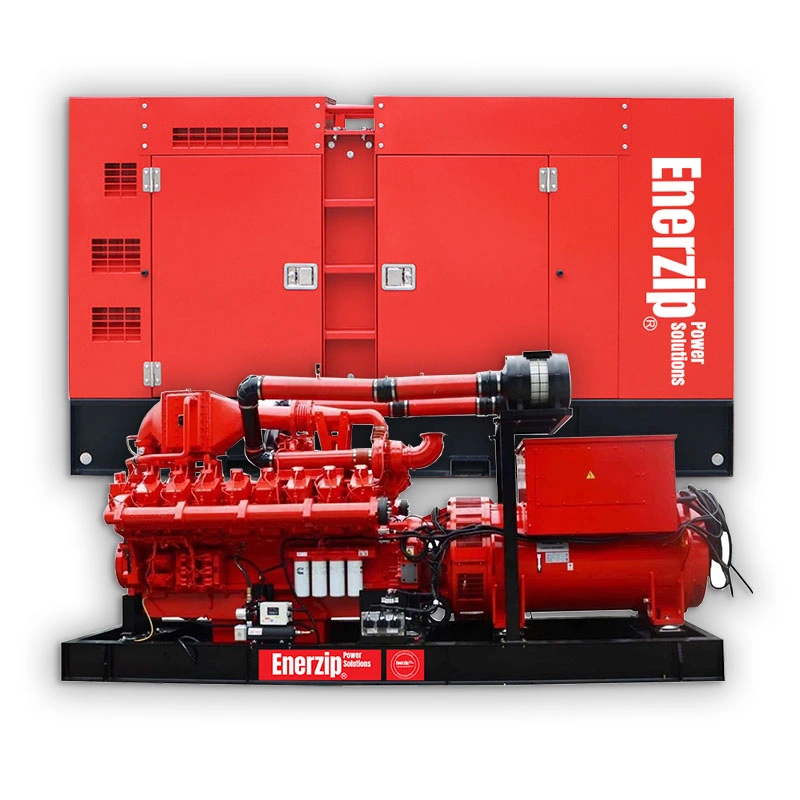
Enerzip biogas generator sets are available in a power range of 20–1,875 kVA and are divided into two series to meet different project requirements.
The E Series is suitable for farm-scale and distributed biogas projects, characterised by simple operation, lower investment costs and ease of local maintenance. The C Series is designed for industrial-scale biogas projects and is suitable for applications requiring extended operating hours, combined heat and power (CHP) heat recovery, grid-connected operation or multi-unit systems.
Before selecting a generator set, the quality of the biogas should be tested. Methane content, gas pressure, H₂S content, moisture, condensate and siloxanes can all affect combustion stability, output power, maintenance costs and service life.
Enerzip will recommend the appropriate series and configuration based on the gas analysis report, required power, operating hours, load conditions, operating mode and site conditions.
Enerzip offers two series of biogas generators, suitable for projects of varying scales. The E Series is ideal for farm-scale and distributed biogas projects, whilst the C Series is designed for industrial-scale biogas power generation, CHP (combined heat and power) systems, grid-connected projects and multi-unit applications.
Biogas quality varies depending on the specific site conditions. Before recommending a generator set, Enerzip will review methane content, gas pressure, H₂S content, moisture levels, condensate conditions and existing gas treatment information to ensure the unit configuration is optimised for the actual fuel conditions.
For projects capable of utilising recovered heat, Enerzip can provide CHP-ready configurations suitable for jacket water or exhaust heat recovery. Depending on project requirements, configurations for stand-alone operation, ATS, parallel operation, synchronisation control and grid connection control can also be provided.
Enerzip assists customers with series selection, gas data review, configuration confirmation, communication regarding installation issues, commissioning coordination, spare parts planning and repeat order documentation. For CHP, grid-connected or multi-unit projects, the main technical scope should be confirmed prior to production.
Biogas power generation units convert gas produced from organic waste into electricity. Common gas sources include biogas from livestock manure, anaerobic digestion gas from sewage treatment, landfill gas, biogas from food processing wastewater, and other anaerobic digestion gases.
Biogas differs from pipeline-grade natural gas. Its methane content, CO₂ content, pressure, moisture content, H₂S content, condensate and impurity levels vary from project to project. The International Energy Agency describes biogas as a mixture of methane, CO₂ and small amounts of other gases produced by anaerobic digestion, the composition of which depends on the feedstock and production pathway.
Consequently, biogas generator sets should be selected based on gas conditions, required power, operating hours, site conditions and gas treatment. Selection based solely on kVA may result in unstable combustion, reduced output, increased maintenance costs or a shorter service life.
Enerzip utilises two series to cover different types of biogas power generation applications.
E Series Biogas Generator Sets – 20–250 kVA are suitable for farm-scale and distributed biogas users. This series is ideal for livestock farms, rural cooperatives, small-scale food processing facilities, and off-grid or weak grid areas, with a focus on simple operation, lower investment and ease of local maintenance.
C Series Biogas Generator Sets – 20–1875 kVA are suitable for industrial-scale biogas power generation projects. This series is ideal for sewage treatment plants, landfill gas projects, large livestock farms, food and beverage wastewater projects, industrial organic waste treatment facilities, and waste-to-energy power stations. Such projects typically require extended operating hours, CHP heat recovery, grid-connected operation, or multi-unit systems.
This series classification helps customers avoid mismatched selections: it prevents small farms from choosing overly complex equipment, whilst ensuring industrial projects do not opt for units that are too basic.
Before selecting a biogas generator set, the gas conditions should be assessed, particularly methane content, gas pressure, moisture, H₂S, condensate, and any potential siloxane risks.
Gas consumption data should be treated as indicative values. Actual gas consumption depends on methane content, lower heating value, gas pressure, temperature, operating load and site conditions. Final gas consumption should be confirmed based on an actual gas analysis report.
For biogas with high levels of H₂S, moisture, condensate or siloxane risk, a suitable gas treatment system should be installed prior to long-term operation. This is particularly important for landfill gas and industrial waste-to-energy projects.
Some biogas projects can utilise recovered heat from jacket water or exhaust gases for anaerobic digester heating, domestic hot water, or process heat requirements. Where there is an available heat load on-site, a CHP-ready configuration can help improve overall energy efficiency. The IEA Bioenergy also describes biogas as a fuel suitable for heating, power generation, and combined heat and power (CHP).
Grid connection and power export depend on local grid permits, protection settings, metering requirements and project design. Enerzip can provide generator configurations for grid synchronisation and multi-unit operation in such applications; however, local grid connection requirements should be confirmed by the project owner, EPC contractor or electricity supplier.
For landfill gas projects, purchasers may also refer to the U.S. EPA Landfill Methane Outreach Program for general background information on landfill gas recovery and utilisation.
To expedite the quotation process, please provide as much of the basic project information as you have available:
Gas data: CH₄ content, CO₂ content, H₂S content, gas pressure, moisture or condensate conditions; please also provide siloxane data if available.
Power requirement: Required kVA/kW, daily operating hours and details of the main loads.
Operating mode: Stand-alone operation, ATS, grid-connected operation, or whether multiple units need to be operated in parallel.
Site conditions: Ambient temperature, altitude, indoor/outdoor installation, and enclosure requirements.
Biogas power generation units are suitable for scenarios where organic waste gases can be collected and converted into electricity. Common applications include livestock farms, sewage treatment plants, landfill sites, food processing plants, CHP systems, and larger-scale waste-to-energy power stations.
The appropriate configuration depends on gas quality, gas production volume, operating hours, heat recovery requirements, and whether the unit is to operate in stand-alone mode, with an ATS, in parallel, or connected to the grid.
Pig farms, poultry farms, dairy farms and integrated agricultural projects can utilise biogas from manure and slurry for on-site power generation. Typical loads include ventilation fans, feeding systems, water pumps, lighting, heating equipment and small-scale processing machinery.
For small and medium-sized farms, ease of operation and local maintenance are often more important than complex grid-connection features. Larger farms with more stable gas production may consider higher-capacity units or CHP heat recovery solutions.
Sewage treatment works can utilise biogas generated from sludge anaerobic digestion to generate electricity, powering pumps, blowers, control systems, lighting and other on-site loads.
Where on-site heat recovery is feasible, CHP configurations can also be employed to support the heating of anaerobic digesters and improve overall energy efficiency. For such projects, gas quality, operating hours and maintenance space should be assessed prior to selecting a generator set.
Landfill gas projects typically face challenges such as fluctuating methane content, moisture, H₂S and potential siloxane risks. Appropriate gas treatment is essential prior to long-term operation.
Biogas generator sets can be used at active or closed landfills to convert collected landfill gas into electricity. Larger projects may require phased expansion, multi-unit operation, grid synchronisation and maintenance planning.
Breweries, distilleries, starch mills, palm oil mills and other food processing plants can generate biogas from organic wastewater or organic residues.
The electricity generated can help offset the plant’s electricity consumption; if the plant has suitable thermal requirements, recovered heat can also be used for hot water or low-pressure process heat. Gas treatment and operating hours should be confirmed during the project design phase.
Some biogas projects can utilise heat from engine cylinder jacket water and exhaust gases. This heat can be used for heating anaerobic digesters, providing hot water on-site, or meeting process heat requirements.
CHP is only of practical value where there is a genuine heat load on-site. If the recovered heat cannot be utilised, a standard power generation configuration may be more practical.
Industrial-scale biogas power plants may require grid synchronisation, multi-unit parallel operation, load sharing and phased expansion.
Such projects require clarification of gas data, protection settings, metering requirements and local grid permits. Enerzip can provide generator configurations required for grid connection or multi-unit operation, but specific grid connection requirements should be confirmed by the project owner, EPC contractor or local electricity supplier.
Yes. If a full gas analysis report is not yet available, you can initially provide the gas source type, estimated methane content, required kVA/kW, operating hours and application scenario. Enerzip can provide a provisional quotation; the final model, gas consumption and gas treatment requirements should be confirmed once the gas report has been finalised.
Natural gas generators typically use cleaner, more stable piped natural gas, whereas biogas generators use gas derived from manure, sludge, landfill gas or organic wastewater. Biogas may contain higher levels of moisture, H₂S, condensate and siloxanes, and its methane content can vary; therefore, gas quality and gas treatment require more careful scrutiny.
Yes, but the gas fluctuations must remain within the acceptable range of the selected generator. Significant variations in methane content, gas pressure, moisture or H₂S may affect output power, combustion stability and maintenance costs. For unstable gas sources, it is recommended to install gas treatment equipment and to monitor gas quality regularly.
This depends on the scope of supply agreed between both parties. Enerzip can provide recommendations on gas conditions based on the generator’s requirements. H₂S removal, moisture separation, filtration, condensate drainage, pressure regulation or siloxane control may be the responsibility of the project owner, EPC contractor or gas treatment supplier, or may be included within Enerzip’s scope of supply following confirmation prior to quotation.
The E Series is suitable for small-scale farm-level projects, with a focus on simple operation, lower investment and convenient local maintenance. The C Series is suitable for industrial-scale biogas projects, applicable to longer operating hours, CHP heat recovery, grid-connected operation or multi-unit systems. If there are plans for future expansion, please provide current gas production figures and future plans.
It is necessary to confirm whether the CHP site can actually utilise the recovered heat, for example for heating anaerobic digesters, hot water or process heat. For grid connection, it is necessary to confirm local grid permits, protection settings, metering, synchronisation requirements and grid connection rules. These details should be clearly confirmed prior to production.