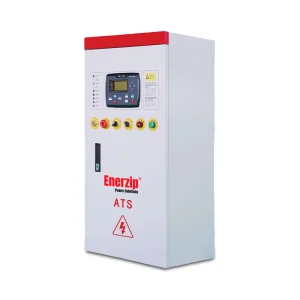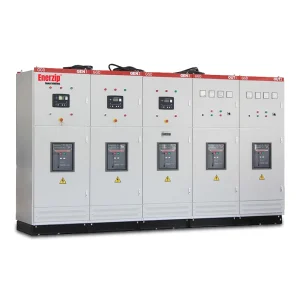

Enerzip supplies control and power distribution systems for generator set power projects. Our product range includes Automatic Transfer Switches (ATS) for switching between mains and generator power sources, as well as Paralleling & Grid-Connect Systems for synchronising multiple generator sets, load sharing and grid connection control.
These systems are suitable for applications such as commercial buildings, hospitals, data centres, factories, mines, remote power stations and industrial facilities, where they are used to switch, control and monitor generator power supplies, or to coordinate the operation of multiple generator sets.
The appropriate control and power distribution system should be configured based on the on-site power structure, operating mode, number of generators, load type, circuit breaker ratings, protection requirements and communication interfaces.
Features:
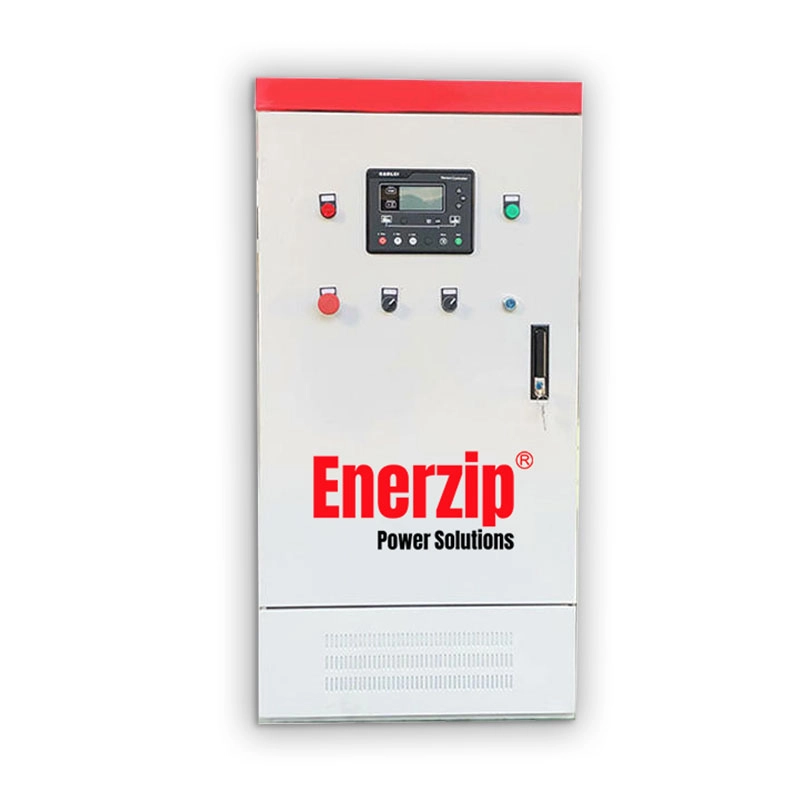
Enerzip’s generator set control and power distribution products comprise two main series: the ATSE Series Automatic Transfer Switches and the EZ-PGC Series Paralleling & Grid-Connect Systems.
The ATSE Series is used to switch loads between mains and generator power sources. It covers a range of 80A–3200A and is commonly used in commercial buildings, hospitals, data centres, telecommunications sites, factories and other backup power systems. For automatic transfer switch equipment, purchasers may also refer to IEC 60947-6-1.
The EZ-PGC Series is designed for scenarios where multiple generator sets need to operate in parallel. It supports synchronisation control, kW/kVAr load sharing, circuit breaker control, automatic generator start-stop logic, and grid-connected operation where permitted. For low-voltage switchgear and control panel components, purchasers may also refer to IEC 61439-1.
ATS is typically used in single-generator standby systems; however, for multi-unit power stations, isolated power systems, peak-shaving applications or grid-connected operation, synchronisation and power management systems are usually required.
When providing solutions, Enerzip will review single-line diagrams, operating modes, the number of generators, circuit breaker ratings, protection scope, communication requirements and on-site control interfaces.
Enerzip addresses two key control requirements in generator power systems: the ATSE Series is designed for automatic switching between mains power and generators, whilst the EZ-PGC Series is designed for synchronisation, load sharing and grid connection control across multiple generator sets. This helps purchasers select the appropriate system based on project requirements, rather than applying a single cabinet solution to all projects.
When providing solutions, Enerzip reviews single-line diagrams, ATS rated current, number of generators, operating modes, circuit breaker ratings, protection scope and communication requirements. This ensures that the cabinet design aligns with the actual on-site control logic, such as standby switching, island operation, parallel operation, peak shaving, or grid-connected operation where permitted.
Prior to dispatch, Enerzip conducts checks against the confirmed control and wiring scope, including power transfer logic, mechanical/electrical interlocks, circuit breaker operation, controller communication, I/O mapping, alarm signals and status feedback. For parallel systems, synchronisation and load sharing logic are verified against the confirmed project scope.
Enerzip assists customers with ATS switching time coordination, generator start-stop logic, synchronisation parameters, communication interface verification, and PLC/SCADA/BMS signal planning. For grid-connected, black start, peak shaving or multi-unit systems, control boundaries and commissioning scope are confirmed prior to production.
Enerzip Genset Control & Distribution comprises two product lines: the ATSE Series – Automatic Transfer Switches (ATS) and the EZ-PGC Series – Paralleling & Grid-Connect Systems.
The ATSE Series is designed to switch loads between utility power and standby generator power, and is primarily used in single-generator standby systems and emergency power systems. When utility power fails, voltage is lost, or the grid becomes unstable, the load must be switched safely.
The Enerzip ATSE system has a current range of 80A to 3200A. Depending on the selected model and switching configuration, the switching time can be completed in ≤1 second. Features may include automatic switching, manual operation, switching and return delays, generator start signals, mechanical and electrical interlocks, power source position indication, and status feedback.
The EZ-PGC Series is designed for multi-generator systems, handling generator synchronization, kW/kVAr load sharing, circuit breaker operation, generator start-stop sequencing, fault isolation, and grid-connected operation where local regulations permit.
For large power plant systems, this system can be configured to synchronize up to 99 generator sets. The final cabinet layout is determined by the controller platform, circuit breaker arrangement, busbar layout, communication network, protection logic, and operating mode. Under suitable generator and control conditions, the time from startup to circuit breaker closing can be completed in ≤10 seconds.
In many generator rooms or power plants, the ATS and synchronizing cabinet are installed together. The ATS is responsible for selecting the power source between the utility grid and the generator power supply; the synchronizing cabinet controls how multiple generator sets start, synchronize, share the load, and disconnect, while protecting the common busbar.
Prior to production, Enerzip reviews the project single-line diagram, number of generator sets, rated power of each unit, ATS rated current, circuit breaker rated parameters, available fault current levels, load conditions, operating modes, controller brand, communication protocols, monitoring signals, and installation requirements.
Communication terminals can be configured with dry contacts, RS485, Modbus RTU, Modbus TCP/IP, CANbus, PLC, SCADA, or BMS interfaces according to project requirements.
For the planning of low-voltage switchgear and control cabinets, the purchaser may also refer to the IEC 61439-1 standard for low-voltage switchgear and controlgear assemblies.
Prior to shipment, Enerzip will configure the ATS cabinet or parallel cabinet to match the generator set, switchgear, protection logic, monitoring signals, and on-site control requirements.
To quote correctly, please send:
Power: kW/kVA, voltage, frequency, phase, and rated current.
System: ATS, paralleling, grid-connect, or ATS + paralleling.
Gensets: quantity, rating, controller brand, and future expansion if any.
Loads: main loads, motor loads, UPS/IT/medical loads if any.
Site: installation country, single-line diagram if available, and required signals such as RS485, Modbus, CANbus, SCADA, BMS, or dry contacts.
Commercial buildings and high-rise facilities typically use ATS panels to provide backup power switching for emergency lighting, elevators, fire pumps, smoke exhaust systems, access control systems, security systems, and building management equipment.
The ATSE cabinet is responsible for switching designated loads between utility power and backup generator power. For large buildings configured with multiple generator sets, a parallel cabinet can be added to facilitate generator synchronization, staged load restoration, and future capacity expansion.
Data centers, server rooms, telecommunications hubs, and network facilities typically require ATSE cabinets, generator controllers, and UPS coordination and monitoring signals to work in tandem.
The ATSE cabinet handles the switchover from utility power to generator power. The synchronization cabinet manages multiple generator units on the generator side, including synchronous synchronization, kW/kVAr load sharing, generator start-up and shutdown sequences, and fault isolation.
Common monitoring signals include ATS position, circuit breaker position, generator operating status, number of online generators, alarms, trips, and operating modes. These signals can be integrated into a BMS or SCADA system via dry contacts, RS485, Modbus RTU, Modbus TCP/IP, CANbus, or other agreed-upon interfaces.
Hospitals and medical facilities utilize generator control and transfer systems to provide backup power support for operating rooms, ICU equipment, medical gas systems, surgical lighting, emergency lighting, fire protection systems, critical HVAC, laboratories, and diagnostic equipment.
The ATSE cabinet is responsible for switching between utility power and backup generator power. For large hospitals or medical campuses, parallel systems can coordinate multiple generator sets, support redundant configurations, and restore power to different load zones in stages.
Since hospital loads are typically zoned by priority, clear power indication, interlocks, and maintenance isolation are critical.
Factories, process plants, pump stations, and industrial parks typically house water pumps, air compressors, conveying equipment, fans, variable frequency drives (VFDs), welding equipment, control panels, and production lines.
ATS panels are used for backup power switching from utility power to generator power. If multiple generator sets are configured on-site, parallel control can manage synchronous synchronization, load sharing, generator start-stop sequencing, and common busbar protection.
This configuration is typically used in scenarios requiring backup power for specific production loads, heavy-duty motor loads, or unstable utility power environments.
Mining sites, drilling sites, oilfield facilities, remote camps, and off-grid industrial sites typically use multiple generator sets because on-site loads fluctuate during operation.
Parallel control cabinets manage generator synchronization, kW/kVAr load sharing, automatic start-stop sequencing, and fault isolation. If a generator trips or is shut down for maintenance, the remaining units can continue operating according to the project’s control logic.
Such systems typically require consideration of dust, high temperatures, vibration, extended runtime, cable feed-in, cabinet protection, and remote monitoring requirements.
Airports, ports, subway systems, substations, water treatment plants, and municipal facilities use generator control systems to provide backup power for lighting, water pumps, communication systems, control rooms, monitoring equipment, protective relays, and safety systems.
ATSE panels manage the switching between utility power and generator power. When multiple generator sets need to operate together, or when the power system requires staged load restoration, island operation, or grid-synchronization control as permitted by local regulations, synchronizing and grid-synchronization panels can be configured.
Such projects typically require the transmission of power supply status, circuit breaker positions, generator operating status, alarm signals, and trip signals to the central control room.
In weak grids, isolated systems, or hybrid power systems, diesel or gas generator sets may operate in conjunction with solar power, battery storage, or utility power.
The synchronizing and grid-connection cabinet manages generator start-up and shutdown sequences, load distribution, island operation, and grid-connection control where permitted. Communication interfaces can be reserved as needed for PLCs, SCADA systems, BMS, or on-site energy management systems.
The selection of a suitable ATS depends on the rated current of the generator system (80A to 3200A) and the type of load. We recommend configuring the system based on the site’s single-line diagram (SLD), circuit breaker ratings and switching time requirements (our system achieves switching times of ≤1s), whilst ensuring both mechanical and electrical interlocks are in place to guarantee safety.
The scalability of our parallel control system supports everything from a single standby unit to up to 99 generator sets in parallel synchronisation. The system enables automatic power sharing (kW/kVAr), automatic generator addition/removal logic, and load management.
Yes. Our system is designed to be compatible with leading global controller brands, including Deep Sea Electronics (DSE), ComAp, DEIF and SmartGen (Zhongzhi), and can be customised for integration according to customer preferences or existing systems.
We utilise components compliant with the IEC 60947-6-1 standard and conduct rigorous functional testing prior to shipment. For critical facilities, we provide logic verification, status feedback interfaces (RS485/Modbus) and manual/automatic switching modes to ensure seamless power transition in the event of a mains failure.
Yes. The EZ-PGC series is specifically designed for grid-connected applications and supports load sharing, peak shaving and island mode switching. We incorporate the necessary protection and synchronisation verification into the control logic in accordance with local grid regulations.
Please provide: single-unit power/voltage/frequency, number of units, controller brand requirements, load type (e.g. motors, UPS, IT loads) and communication protocol requirements (e.g. Modbus TCP/IP, CANbus, etc.).
Enerzip offers customised cabinet designs for harsh environments, taking into account dustproofing, high-temperature resistance, vibration resistance and long-distance transport requirements. We also support remote monitoring interfaces (SCADA/BMS), enabling operations and maintenance personnel to monitor the power status in real time from a remote location.
Our ATS complies with the IEC 60947-6-1 standard, whilst our low-voltage switchgear and controlgear comply with the IEC 61439-1 standard. All products undergo rigorous I/O mapping and protection logic testing prior to leaving the factory.
Fully supported. Our control system features multiple communication interfaces, including Modbus RTU, Modbus TCP/IP, CANbus and dry contact signals, allowing for easy integration with PLC, SCADA or BMS systems for centralised monitoring.
Enerzip provides hardware supply and system integration support, including: coordination of ATS switching times, optimisation of generator start-stop logic, guidance on parallel operation parameter tuning, and verification of communication interfaces.