Written by: Enerzip Power Technology (Weifang) Co., Ltd. – Content & Technical Marketing Team
Reviewed by: Enerzip Power Technology (Weifang) Co., Ltd. – Applications & Integration Team
Last updated: 08-Apr-2026
Update policy: This guide is reviewed when common project requirements for voltage selection, generator packaging, enclosure noise targets, transport certification, canopy and container structural practices, protection scope, or outdoor installation expectations materially change.
Scope: Practical guidance for selecting between low voltage and 3.3–13.8kV generator systems (diesel / natural gas / biogas), focused on feeder distance, current level, site distribution architecture, motor starting, protection scope, packaging, and real installation conditions.
Note: In this article, “High Voltage Generator” follows common generator-industry usage for 3.3kV, 6.3/6.6kV, 10.5kV, 11kV, and 13.8kV generator sets.
Introduction
For many overseas buyers, the real question is no longer whether a High Voltage Generator looks more advanced than a Low Voltage Generator. The real question is whether a 3.3kV, 6.3/6.6kV, 10.5kV, 11kV, or 13.8kV generator will make the entire project more practical, more scalable, and easier to operate over the long term.
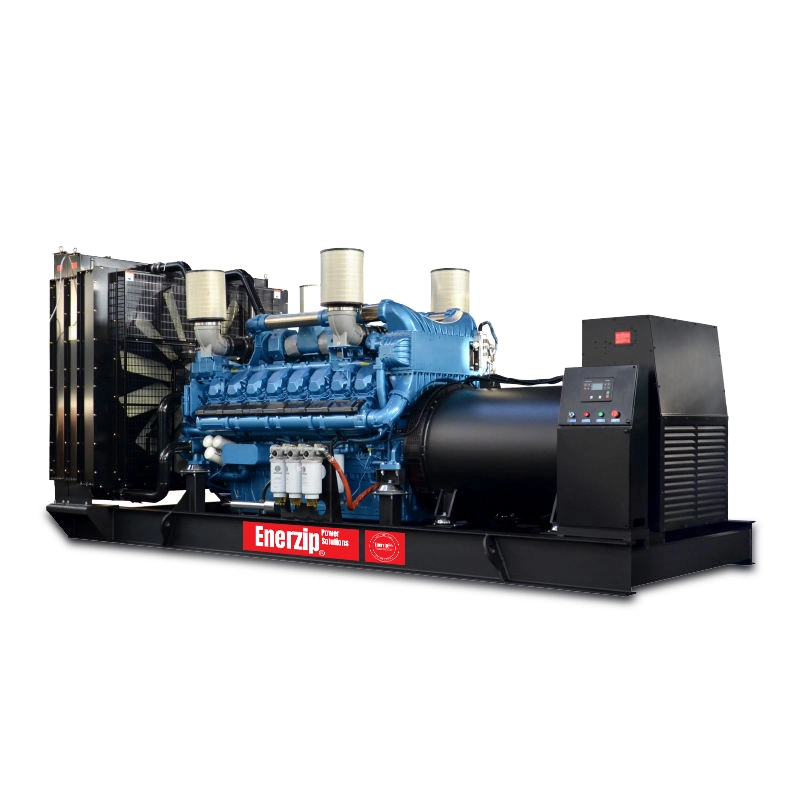
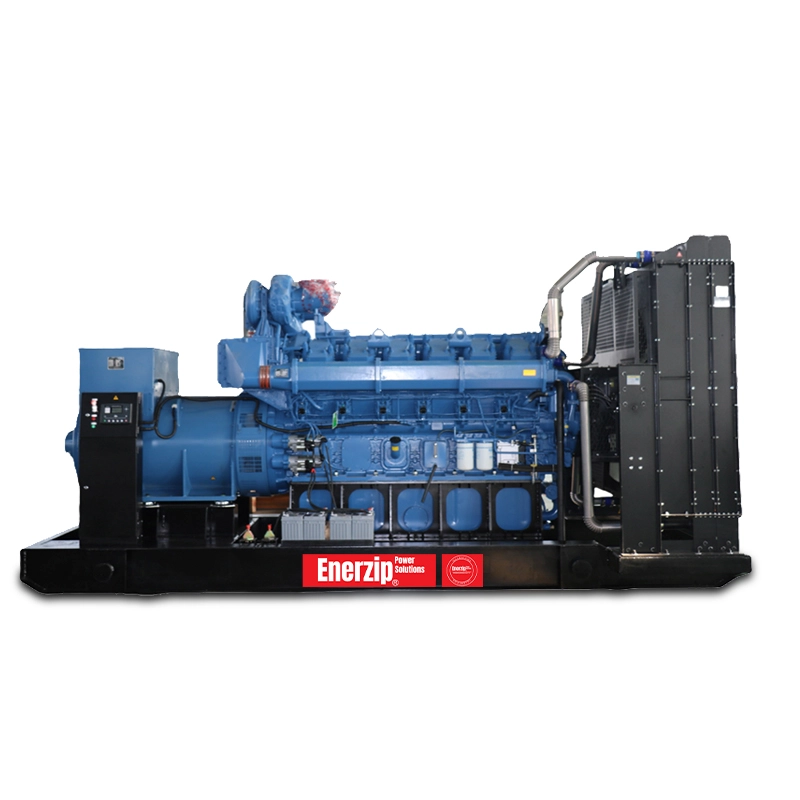
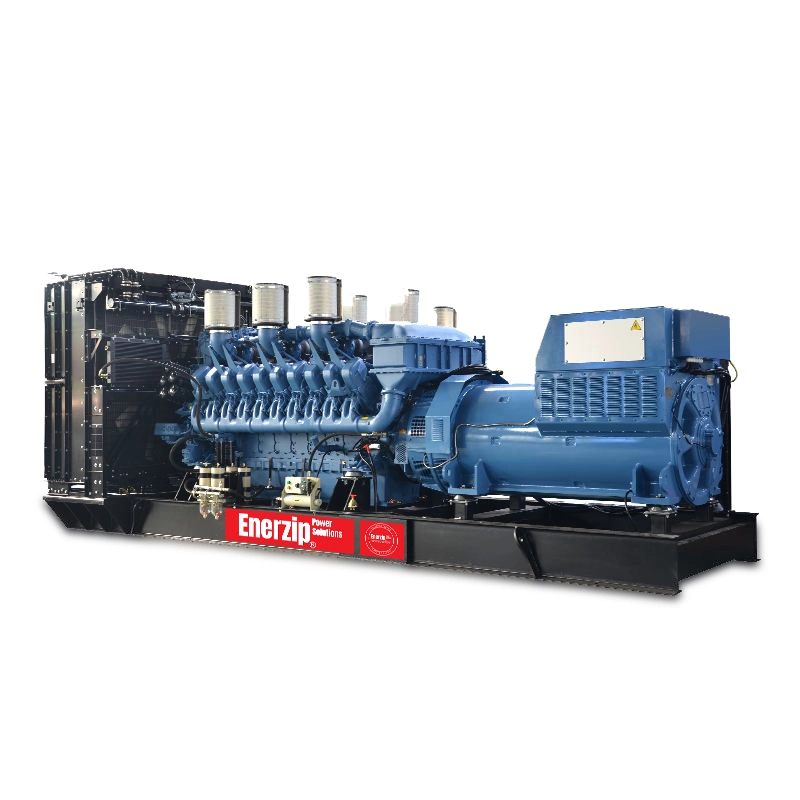
In real industrial power projects, voltage level is not just a generator parameter. It affects current, cable size, voltage drop, switchgear complexity, grounding philosophy, container layout, protection coordination, maintenance access, and future expansion. That is why the same 2000kW requirement can lead to very different engineering answers. On one site, a Low Voltage Generator may still be the right solution. On another, a 10.5kV or 11kV containerized diesel generator may be the better choice, especially when the project already falls into the scope of Enerzip’s High Voltage Generators Sets Series.
For overseas buyers comparing a High Voltage Generator manufacturer in China with local or regional options, the difference is rarely just engine brand or nameplate power. The real difference usually appears in electrical integration, packaging logic, protection scope, and how well the supplier understands the site distribution problem.
At Enerzip, we do not believe buyers should move to high voltage because it sounds larger or looks more impressive in a quotation. We believe buyers should move to 3.3–13.8kV only when low-voltage distribution stops being the most economical, practical, or reliable answer.
That is the central idea behind this guide.
Executive Summary
A 3.3–13.8kV High Voltage Generator usually deserves serious consideration when one or more of the following conditions apply:
- the total plant capacity is already in the multi-megawatt range
- the generator yard is far from the main loads
- the site already distributes power on a medium-voltage backbone
- the facility has large motors, harsh load steps, or heavy industrial starting duty
- future expansion will add more generators, more feeders, or more distributed load zones
- the project is better served by a centralized power plant than by multiple low-voltage sets
If the project is compact, the major loads are close to the generator room, and the switching logic is relatively simple, a Low Voltage Generator is often still the better answer.
At Enerzip, we do not treat 3.3–13.8kV output as a prestige upgrade. We treat it as a distribution decision. High voltage makes sense when it improves the whole project, especially cable routing, system scalability, centralized control, and long-distance power distribution, not when it only upgrades the generator nameplate.
Enerzip’s View: Voltage Is a Distribution Decision, Not a Prestige Decision
This is where Enerzip’s viewpoint differs from many generic comparison articles.
At Enerzip, we do not treat 3.3–13.8kV output as a prestige upgrade. We treat it as a distribution decision.
In our experience, projects are often misjudged because buyers compare engine brand, rated power, and generator price first. But the biggest problems usually appear later, not on the engine nameplate. They appear in cable routing, electrical-room congestion, long-feeder voltage drop, protection selectivity, synchronizing logic, high-ambient ventilation, and containerized installation details.
That is why we believe a project should move from a Low Voltage Generator solution to a High Voltage Generator solution only when the site layout, load behavior, feeder distance, redundancy strategy, and future expansion path justify that move.
In simple words:
The site decides the voltage before the catalog does.
This principle is especially important for international buyers comparing offers from different countries, brands, and integration styles. Two suppliers may quote similar engine power, but the real difference often lies in how they understand the site distribution problem. One supplier may only sell a generator. Another supplier may understand the electrical system that the generator has to serve.
That is the difference Enerzip believes buyers should focus on.
Why the Same Power Requirement Can Lead to Different Answers
Many buyers assume that if two projects both need around 2MW, they should receive similar generator solutions. In practice, that is often wrong.
A 2MW standby system for a single industrial building can still be a very reasonable Low Voltage Generator project if the generator is close to the loads and the distribution network is compact. But a 2MW requirement on a large waterworks, a mining site, a data center campus, a treatment plant, or a remote industrial park may point strongly toward 10.5kV or 11kV because the real challenge is no longer generation alone. The real challenge is how power travels through the site.
This is one of the main reasons buyers should avoid treating generator selection as only an engine comparison. A bigger engine does not automatically mean the project should use a High Voltage Generator. At the same time, a project can become a high-voltage project even if the engine size itself does not look unusual on paper.
That is why low voltage versus high voltage should never be decided only from the generator datasheet. It should be decided from the one-line diagram and distribution logic of the site.
Low Voltage vs High Voltage: Practical Comparison
| Question | Low Voltage More Likely | High Voltage More Likely |
|---|---|---|
| Total plant size | Single building or moderate load | Multi-MW site or distributed load zones |
| Feeder distance | Short | Long |
| Distribution architecture | Local LV loads | Existing MV backbone or centralized energy center |
| Motor starting severity | Moderate | Large pumps, chillers, compressors, crushers |
| Expansion plan | Limited | Multi-phase expansion or multi-unit power plant |
| Protection complexity tolerance | Lower | Higher |
| Electrical room pressure | Manageable | LV copper and switchgear becoming bulky |
| Typical project logic | Simple standby | Centralized standby, prime, peaking, or microgrid support |
This table gives the fastest summary of the article: when the project starts behaving like a power distribution system, high voltage becomes more relevant.
When a Low Voltage Generator Is Still the Better Answer
A Low Voltage Generator is still the right answer for many real-world projects.
If the generator is close to the loads, the electrical distances are short, the protection and transfer logic are straightforward, and the site does not need a campus-style power architecture, a low-voltage system can still deliver the best balance of simplicity, speed, and maintainability.
- single-building standby systems
- many commercial backup projects
- concentrated hospital load centers
- regional telecom facilities
- medium-size manufacturing buildings
- projects where local contractors and service teams are much more familiar with LV switchgear
At Enerzip, we believe buyers should be careful not to “upgrade” into high voltage too early. A project does not become better simply because the quoted generator voltage is higher. If the site is compact and the distribution route is short, a High Voltage Generator may add coordination, switchgear, and commissioning complexity without creating enough economic benefit in return.
The lowest generator price does not always produce the lowest total project cost.
In the same way, the highest generator voltage does not always produce the best overall project result.
This is especially true when:
- the site has no major future expansion plan
- feeder runs are short
- the loads are highly concentrated
- the operator prefers simpler local maintenance
- the project schedule favors less integration complexity
In these cases, a well-engineered low-voltage system may outperform a needlessly complicated high-voltage layout in total project efficiency.
When 3.3–13.8kV Starts to Make More Sense
A 3.3–13.8kV High Voltage Generator starts to make more sense when the project stops behaving like a building standby system and starts behaving like a site-wide power system.
1. Multi-Megawatt Capacity
Once the plant grows into a serious multi-megawatt facility, low-voltage current becomes harder to manage economically. Cables become larger, busbars become heavier, rooms become more crowded, and the margin for future expansion becomes tighter.
This is one reason High Voltage Generator packages are increasingly relevant in large data centers, industrial parks, mining sites, utility-support plants, large pumping stations, and other projects where capacity is expected to grow rather than remain fixed.
2. Long Feeder Distance
Long feeder distance changes the logic of the project.
If power has to travel across a large campus, remote process blocks, pump stations, shafts, conveyor areas, airport zones, or port infrastructure, low voltage can become physically bulky and commercially inefficient. In those situations, native 3.3–13.8kV output often becomes far more attractive.
3. Harsh Motor Starting and Load Steps
Not all load profiles are equal. Large motors, high inrush current, and violent load steps change the design problem.
In applications such as pumping, crushing, smelting, chilled-water plants, or large industrial ventilation, the question is not just how much power the generator can produce in steady operation. The question is how the system behaves during the hardest starting events and the most demanding transient moments.
That is why Enerzip treats motor-starting behavior and load-step performance as a major part of HV selection logic rather than as an afterthought.
4. Centralized Backup or Prime Power Architecture
Some sites do not want multiple low-voltage sets distributed around separate buildings. They want one centralized energy center that can support parallel operation, protection zoning, staged expansion, and future control integration.
In these cases, 10.5kV, 11kV, or 13.8kV often becomes more logical because the project is now being designed like an electrical plant, not a single standby generator.
5. Future Expansion
Many buyers already know that Phase 2 or Phase 3 is coming.
If the site is expected to expand, choosing the wrong voltage level early can create a costly rebuild later. In many cases, it is more economical to choose the right 10.5kV or 11kV backbone at the beginning than to overload a low-voltage design that looked acceptable only for Phase 1.
6. Better Site-Wide Control Logic
A larger site often needs clearer system logic: staged loading, synchronizing plans, selective protection zones, future feeder additions, and cleaner control boundaries between generation and distribution.
This is where high voltage can make the electrical architecture cleaner, even if it makes individual equipment packages more sophisticated.
Typical Scenario Guide
| Typical Scenario | Suggested Voltage Direction | Why |
|---|---|---|
| Single building standby power | 400V / 480V | Simpler installation and protection |
| Mid-size industrial facility | LV or 3.3kV | Depends on feeder distance and load steps |
| Large pumping station | 6.3/6.6kV / 10.5kV / 11kV | Long feeders and large motor duty |
| Data center campus | 10.5kV / 11kV / 13.8kV | Centralized architecture and future scaling |
| Mining site | 10.5kV / 11kV / 13.8kV | Long-distance distribution and heavy-duty loads |
| Industrial park or utility-support plant | 11kV / 13.8kV | Site-wide distribution and expansion logic |
| Compact urban backup project | LV or compact HV | Depends on footprint, local grid, and room constraints |
This table is not meant to replace engineering study. It is meant to give overseas buyers a faster way to understand whether the project is still inside the low-voltage comfort zone or already moving into high-voltage logic.
Enerzip’s Second View: Above a Certain Point, You Are No Longer Buying Only a Genset
This is another place where Enerzip’s perspective matters.
Once a project enters 3.3–13.8kV territory, the buyer is no longer evaluating only an engine-driven machine. The buyer is evaluating an electrical system that includes:
- alternator insulation design
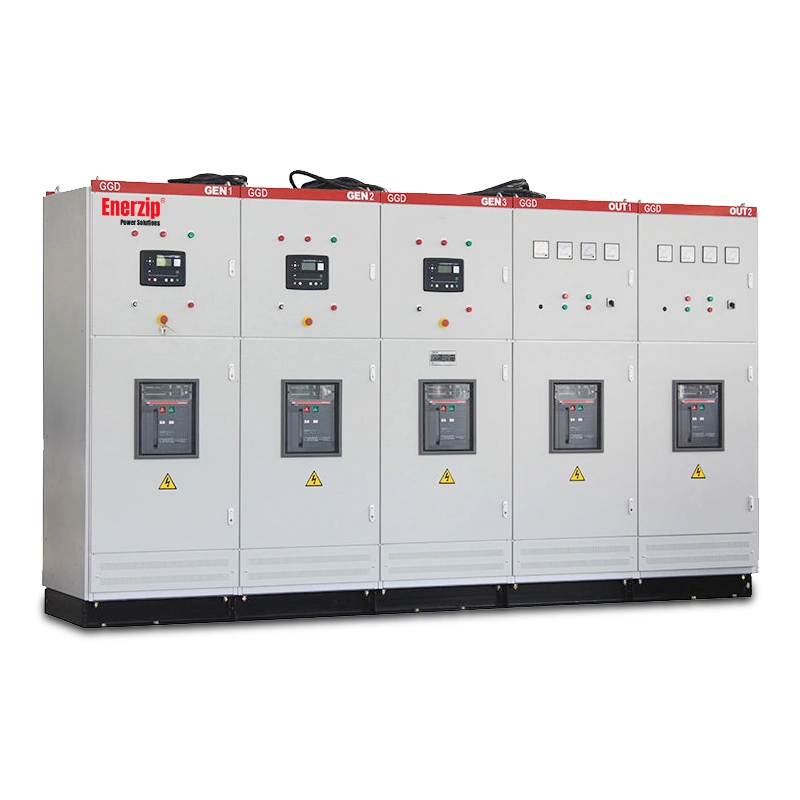
- output breaker philosophy
- metering scope
- grounding philosophy
- relay logic
- synchronization and load sharing
- cable marshalling
- enclosure airflow
- maintenance access
- FAT and SAT expectations
This is one of the biggest differences between a Low Voltage Generator project and a genuine High Voltage Generator project.
At Enerzip, we believe this is where many RFQs become weak. The buyer asks for a price on a generator set, but what the site actually needs is a clear electrical boundary. That is why high-voltage projects should define much more than rated power.
A good RFQ should also answer questions like:
- Is the output breaker included?
- What switchgear scope is part of the package?
- What metering and protection logic are expected?
- Who defines the grounding concept?
- How is synchronization handled?
- Who supports commissioning?
- What is the division between the generator supplier and the site electrical contractor?
If a supplier cannot answer these clearly, the buyer is probably not yet comparing the right suppliers.
Why Packaging Matters: Open Type, Silent, and Containerized Generator Logic
Many buyers search phrases like containerized diesel generator, containerized generator, generator containers, and generator enclosure manufacturers. These are valid search terms, but on high-voltage projects they can also be misleading.
A good high-voltage package is not just a steel shell around a large engine.
For a 3.3–13.8kV project, packaging has to solve several problems at once:
- weather protection
- airflow and thermal margin
- equipment segregation
- safe operator access
- clean conditions for control and switchgear
- high-voltage cable entry space
- maintenance clearance
- noise reduction
- transport and deployment practicality
For projects in hot climates, restricted enclosures, or containerized layouts, buyers should also review Enerzip’s Genset Cooling and Ventilation Guide before finalizing the package design.
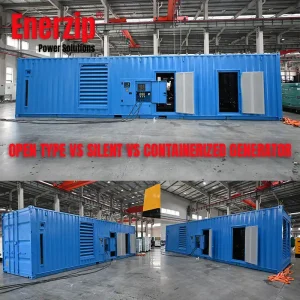
Open Type
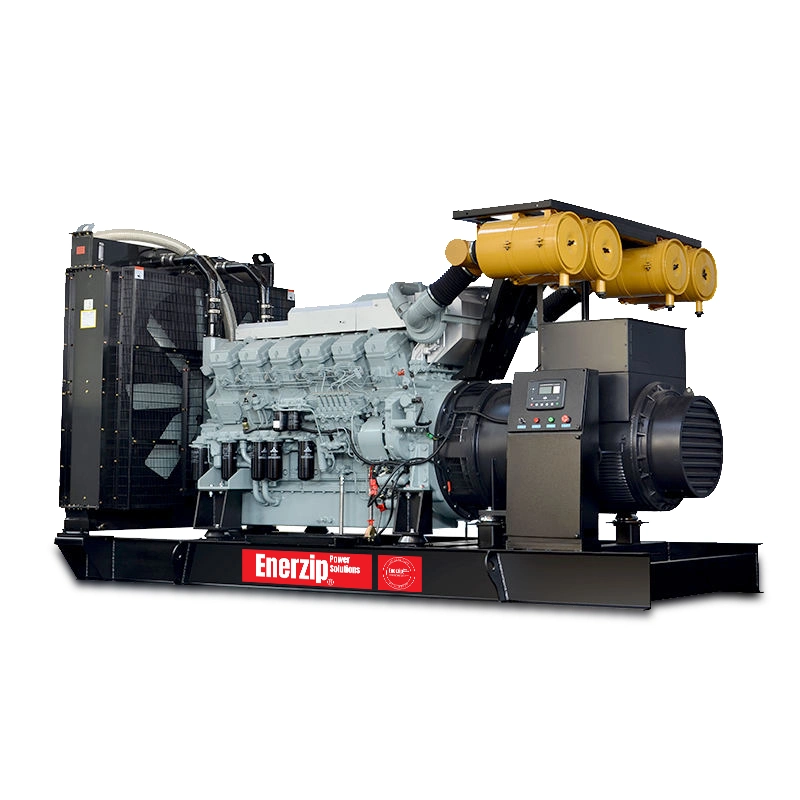
An open type high-voltage generator can be the right answer when the project already has a dedicated power house or generator building. In those cases, the building itself provides environmental protection and service access, while the genset package focuses on the engine, alternator, switchgear, and control interface.
Silent / Weatherproof Canopy
A silent canopy can work for some outdoor high-voltage projects, especially when the site needs weather protection and noise control but does not require a full walk-in electrical room. However, the layout must still allow safe cable entry, adequate airflow, and practical maintenance clearance.
Containerized Generator / Power House
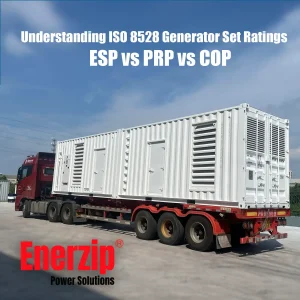
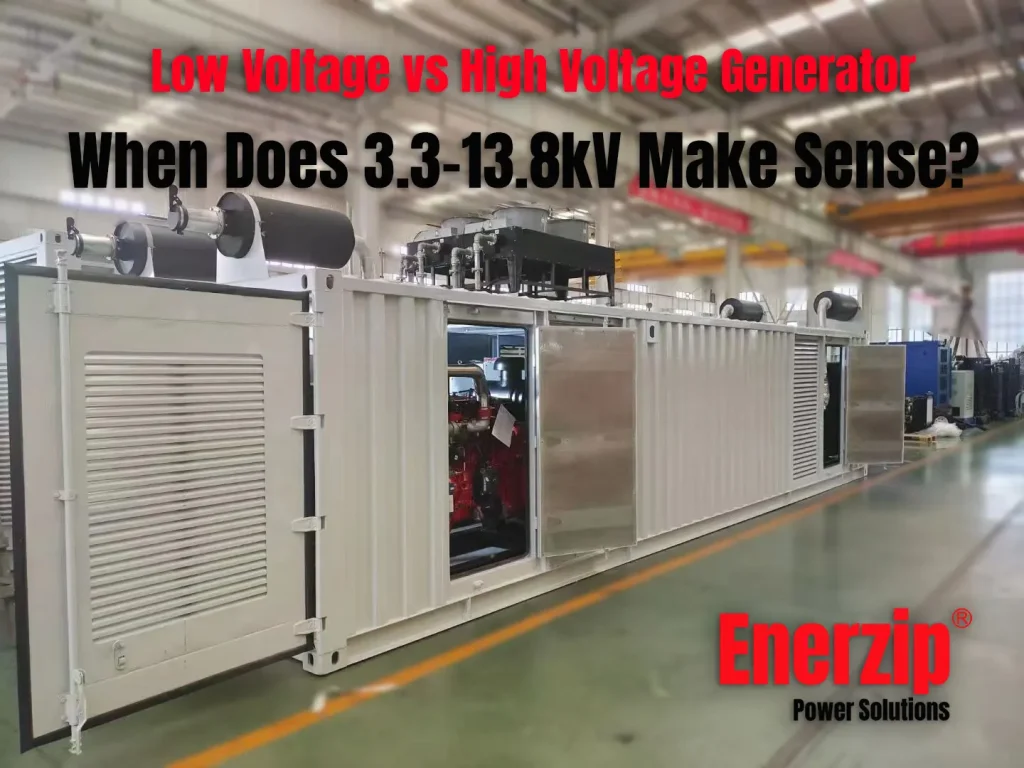
For many outdoor megawatt-class projects, a containerized generator or containerized “Power House” package is the most practical solution. It can combine transportability, weather resistance, compartment separation, noise reduction, and a more organized electrical installation.
At Enerzip, our internal view is:
A good HV container starts with the one-line diagram, the cooling path, and the maintenance route — not the paint color.
That matters because some projects look impressive in layout drawings but become difficult at site level because the airflow path is poor, the cable-entry space is too tight, or the electrical room is not properly separated from the engine bay.
So when buyers talk to generator enclosure manufacturers, they should ask more than:
- How thick is the steel?
- What is the noise level?
- Is the paint marine-grade?
They should also ask:
- How is hot-air recirculation prevented?
- Is there a separate HV room?
- How are heavy armored HV cables landed safely?
- How much clearance is left for termination and maintenance?
- How is airflow engineered under high ambient temperatures and dusty conditions?
Those are real project questions, not cosmetic questions.
How Enerzip Reviews a High-Voltage RFQ
To make this guide more useful for overseas buyers, here is a simplified version of how Enerzip internally reviews a 3.3–13.8kV generator inquiry.
Step 1: Review the Site Distribution Logic
We first ask how the site distributes power today, or how it plans to distribute power after construction. Is the site centralized or decentralized? Are the load zones close together or far apart? Does the facility already have an MV backbone?
Step 2: Check the Hardest Load Event
We do not look only at total kW. We also look at the largest motor, the harshest load step, and the most demanding operating sequence. In many projects, the hardest transient event tells more than the total steady load.
Step 3: Review Feeder Distance and Expansion Path
If the feeder route is long or the site has obvious future expansion, that strongly affects whether low voltage still makes sense.
Step 4: Define Packaging and Installation Constraints
We check whether the project is better suited for open type, silent/weatherproof, or a containerized diesel generator package. We also review noise expectations, service access, ventilation path, transport restrictions, and installation logic.
Step 5: Clarify Protection and Boundary Scope
We confirm what is included and what is not: output breaker philosophy, switchgear boundary, synchronization scope, metering responsibility, and site interface.
Step 6: Match the Right Series, Not Just the Right Power
Only after the distribution logic is clear do we match the most suitable HV platform. This avoids a common mistake: choosing a generator series before understanding the site architecture.
This is one of the most practical ways buyers can reduce mismatch and save time during quotation.
As a generator manufacturer in China, Enerzip believes this step-by-step review is one of the best ways to separate a serious project offer from a simple equipment quotation.
Which Enerzip High-Voltage Series Fits Which Project?
| Project Priority | Recommended Enerzip Series | Typical Logic |
|---|---|---|
| Mission-critical data center / semiconductor | M Series | Fast response, tight stability, critical-load orientation |
| Broad industrial megawatt-class standby or prime | C Series | Strong all-round industrial compatibility |
| Compact footprint site | MS Series | Better fit for tighter spaces and dense sites |
| Serviceability and lifecycle maintenance | P Series | Easier long-term maintenance planning |
| Heavy-duty mining / rough industrial duty | Y Series | Tough structure and strong torque focus |
| ROI-driven bulk power / megawatt-class expansion | W Series | Strong value logic for large-capacity deployment |
This structure helps readers move from general comparison into actual product direction.
It also reflects a more useful truth about high-voltage generator buying: the best series is not chosen by brand prestige alone. It is chosen by project behavior.
For buyers evaluating a China High Voltage Generator supplier, this kind of platform logic is often more useful than simply comparing catalog power ranges.
Common Buyer Mistakes
Even experienced buyers can make the wrong decision if they focus on the wrong variables. Here are some of the most common mistakes Enerzip sees.
Mistake 1: Choosing High Voltage Only Because the Project Is “Large”
A project can be large and still remain a practical low-voltage solution if the architecture is compact enough. “Large” is not the real criterion. Distribution logic is.
Mistake 2: Comparing Only Engine Brand and Price
Engine brand matters, but in a 3.3–13.8kV project it is not the whole story. Packaging, protection, switchgear scope, and commissioning discipline often matter just as much.
Mistake 3: Ignoring Future Expansion
A low-voltage layout that looks acceptable today may become awkward or expensive after expansion. Buyers should evaluate the site path, not only Phase 1.
Mistake 4: Treating the Container as a Cosmetic Item
On high-voltage projects, the enclosure or container is part of the engineering. Poor airflow, bad cable-entry layout, or weak service clearance can create long-term problems.
Mistake 5: Leaving Electrical Boundaries Undefined
Many project delays come from unclear boundaries: who provides what, who trips what, who commissions what, and where the supplier’s scope ends.
Before Asking for a Quote, Prepare These Inputs
This section is practical for overseas buyers and also supports better inquiry quality.
Before requesting a quotation for a 3.3–13.8kV generator project, prepare these basic inputs:
| RFQ Item | Why It Matters |
|---|---|
| Required kW / kVA | Determines plant size and platform direction |
| Output voltage and frequency | Defines alternator, switchgear, and site compatibility |
| Operating mode | Standby, prime, continuous, grid-parallel, peak shaving |
| Largest motor / harshest load step | Critical for transient and load-acceptance design |
| Feeder distance | Important for LV vs HV decision |
| Site ambient temperature / altitude | Affects cooling and derating |
| Packaging preference | Open type, canopy, or containerized diesel generator |
| Synchronization or expansion plan | Important for control and electrical architecture |
| Site single-line diagram if available | Reduces quotation mismatch and scope gaps |
For high-voltage projects, bad quotations often come from incomplete system boundaries rather than from wrong engine selection.
FAQ
Is “high voltage generator 1000kv” a real industrial product category?
No. Buyers do search phrases like high voltage generator 1000kv or high voltage generator 400kv, but those are not realistic native output classes for industrial standby, prime-power, or campus generator projects. In real generator applications, the practical high-voltage range is usually 3.3kV to 13.8kV.
Is a DIY high voltage generator suitable for industrial backup power?
No. A diy high voltage generator is not an appropriate solution for data centers, mining, factories, hospitals, airports, or utility-support projects. Once a project enters 3.3–13.8kV, insulation quality, switchgear, protection, grounding, and commissioning discipline become too important for improvised assemblies.
Is a containerized diesel generator always better than an open type?
Not always. A containerized diesel generator is often better for outdoor deployment, transport, security, and integrated HV packaging. An open set can still be the better answer if the customer already has a proper power house or generator building with engineered ventilation and safe cable routing.
What should I ask generator enclosure manufacturers?
Ask about airflow path, anti-recirculation design, cable entry, service clearance, corrosion protection, internal compartment separation, and whether the package is designed around actual electrical installation rather than transport size alone.
When should I choose 10.5kV or 11kV instead of low voltage?
Usually when the project is multi-megawatt, the feeder distance is long, the site already uses medium-voltage distribution, or centralized architecture is more practical than local LV distribution.
Are all high-voltage generator projects necessarily containerized?
No. Many large outdoor projects use containerized “Power House” layouts, but some installations still use open-type units inside dedicated generator buildings. The correct format depends on site environment, electrical-room design, maintenance access, and deployment speed.
Does high voltage automatically mean lower total project cost?
Not automatically. High voltage often reduces current-related distribution burden, but it also increases electrical integration complexity. The right answer depends on the whole project, not only on the generator.
Can a China generator manufacturer supply both High Voltage Generator and Low Voltage Generator solutions?
Yes. A capable generator manufacturer in China should be able to support both High Voltage Generator and Low Voltage Generator projects, provided the company understands not just the engine package, but also the site distribution architecture, protection boundary, and packaging logic.
Enerzip’s Recommendation
A 3.3–13.8kV High Voltage Generator makes sense when low-voltage distribution stops being the practical answer.
That usually means multi-megawatt plant size, long feeder distance, heavy motor starting, centralized backup or prime-power architecture, or a site that already operates around an MV backbone.
It does not make sense simply because the project sounds large or because high voltage looks better in a quotation.
If an overseas buyer is evaluating a China High Voltage Generator supplier, the key question should not be who offers the highest quoted voltage. The key question should be who understands the whole site distribution logic, the packaging method, the protection scope, and the long-term operating path of the project.
Enerzip’s view is straightforward:
Choose high voltage when it improves the whole project, not when it only upgrades the generator nameplate.
That is the difference between buying a machine and building a dependable power system.
References & Technical Sources
Standards
- GB/T 2820.1-2022, Reciprocating internal combustion engine driven alternating current generating sets — Application, ratings and performance
- GB/T 2820.7-2024, Technical declarations for specification and design
- ISO 8528-1:2018, Reciprocating internal combustion engine driven alternating current generating sets — Application, ratings and performance
- ISO 8528-7:2017, Technical declarations for specification and design
- ISO 8528-12:2022, Emergency power supply to safety services
Technical Sources
- Caterpillar, Understanding Generator Set Ratings
- Caterpillar, Demystifying Generator Set Ratings
- Cummins, Continuing Education for Consulting & Specifying Engineers — includes the “Understanding ISO 8528 Generator Set Ratings” webinar resources
- Cummins, Understanding ISO 8528 Generator Set Ratings (FAQ PDF)