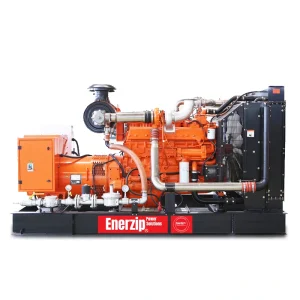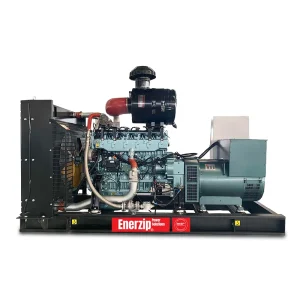

Biogas generator sets turn organic waste gas into dependable power—when the fuel is unstable and the site conditions are demanding. Enerzip biogas gensets are engineered for continuous duty, with configurations adapted to real biogas issues such as moisture/condensate, corrosive compounds, and fluctuating calorific value, making them suitable for waste-to-energy projects that require predictable uptime.
Features:
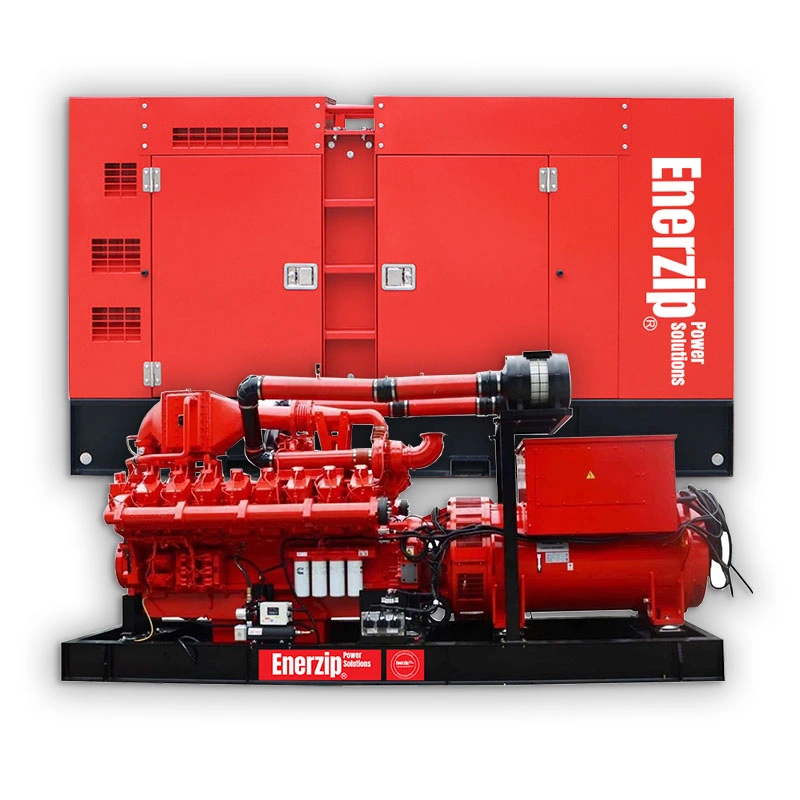
Enerzip’s biogas generator portfolio spans 20–1875 kVA and is organized around how projects actually operate. E Series (20–250 kVA) is built for decentralized biogas users who prioritize affordability and local serviceability, while C Series (20–1875 kVA) targets industrial baseload systems where long-hour runtime, higher availability, and project-grade integration (CHP / grid-parallel / multi-unit) are required.
Instead of using a “one-size-fits-all” gas genset approach, Enerzip selects the proper series and configuration based on your gas report and operating mode—helping reduce common biogas failures such as misfiring, power fluctuation, corrosion-driven wear, and unplanned shutdowns.
Enerzip offers biogas generator sets from 20 to 1875 kVA, covering E Series for farm-scale projects and C Series for industrial baseload. Multiple configurations are available, including open type, silent type, CHP-ready, grid-parallel, and multi-unit solutions.
We value project schedules. With efficient production and clear configuration options, we support quick preparation and responsive quotation based on your gas data, required kVA, and operating mode.
Quality is our core promise. Each biogas genset is built with project-grade integration and inspected for performance stability, protection functions, and key safety checks—supporting reliable long-hour operation in methane environments.
Our team is available 24/7 to assist with selection, installation, commissioning, and troubleshooting, ensuring dependable support throughout your project lifecycle.
Enerzip biogas generator sets convert organic waste gas into dependable electricity—but biogas is never a “stable fuel”. In real waste-to-energy projects, gas composition and quality can vary by feedstock, digester performance, and season. That variability is why biogas gensets must be configured around real field challenges rather than clean-gas assumptions.
In practice, biogas power systems commonly face:
Moisture & condensate: temperature swings and wet gas can create condensate, which may contribute to unstable combustion and corrosion risk if the gas system and drainage logic are not handled properly.
H₂S and corrosive compounds: sulphur-related corrosion and acidic condensate can accelerate wear on gas-path components over long-hour runtime.
Variable methane / calorific value: methane fluctuation (typical CH₄ 40–70%) can lead to misfiring, unstable frequency/voltage, and power fluctuation under load changes if the genset is not matched to the operating mode.
Different operating modes: farm microgrids, WWTP baseload, landfill gas plants, and grid-parallel export projects require different integration approaches (CHP, synchronization, paralleling, safety logic).
To make selection faster and reduce mismatch, this category page follows a two-tier series strategy:
E Series – Biogas Generator Sets (20–250 kVA) — for farm-scale and decentralized sites where affordability, simple maintenance, and local serviceability matter most.
Typical for livestock farms, rural cooperatives, small food processing, and off-grid/microgrid sites.
C Series – Biogas Generator Sets (20–1875 kVA) — for industrial-duty baseload systems where long-hour runtime, higher availability, and project-grade integration are required (CHP / grid-parallel / multi-unit).
Typical for WWTP digesters, landfill gas (LFG) projects, industrial organic waste-to-energy, and IPP-style plants.
For deeper planning and faster quotation, you may also explore: CHP (Combined Heat and Power) Solutions, ATS & Grid Synchronization, and Biogas Gas Conditioning Guide (H₂S removal / dewatering / siloxane risk).
What we typically review to recommend the right series/configuration: CH₄ %, CO₂ %, H₂S (ppm), moisture/condensate condition, siloxanes (if available), required kVA, operating mode (island / ATS / grid-parallel), runtime hours/day, load profile (load steps if possible), and site conditions (ambient temperature / altitude / enclosure requirement).
External references (biogas/WtE background): International Energy Agency (IEA) – biogas & biomethane overview, US EPA – Landfill Methane Outreach Program (LMOP), IEA Bioenergy – biogas/CHP resources.
To avoid under- or over-engineering, we recommend sizing and configuration based on your gas report and operating mode:
Gas data: CH₄ %, CO₂ %, H₂S (ppm), moisture/condensate condition, siloxanes (if available)
Power requirement: required kVA, running hours/day, load profile (load steps if possible)
Operating mode: grid-parallel or island, ATS required or not, multi-unit plan (if any)
Site conditions: ambient temperature, altitude, enclosure requirements, CHP required or not
Biogas generator sets are widely used in waste-to-energy projects where organic waste gas is converted into stable on-site electricity. Typical applications range from decentralized farm digesters to industrial baseload plants, covering scenarios that may require long-hour runtime, CHP heat recovery planning, or grid-parallel operation (project dependent). The following are the most common application fields for biogas power generation.
Livestock Farms & Agricultural Digesters
Used for farm-scale electricity to support barns, ventilation, pumps, lighting, and small processing loads. This scenario often values practical stability under variable digester gas and configurations that fit rural maintenance conditions.
Wastewater Treatment Plants (WWTP) & Sewage Digester Gas
Applied for baseload power generation from digester gas to reduce plant electricity costs and improve energy self-sufficiency. Many WWTP projects also evaluate CHP utilization to support digester heating and improve total efficiency (project dependent).
Landfill Gas (LFG) Waste-to-Energy Projects
Common in landfill methane recovery projects where fuel quality can fluctuate. Biogas gensets support continuous generation, staged capacity expansion, and redundancy planning for higher uptime targets (project dependent).
Food & Beverage Organic Waste-to-Energy
Used by factories handling organic residues and wastewater sludge to offset grid power and stabilize energy cost. Typical use cases include baseload self-use and, where permitted, grid-parallel export for renewable energy projects (project dependent).
CHP-Driven Biogas Power (Heat Recovery Projects)
Suitable for sites that can use recovered heat from jacket water and exhaust systems to support digester heating, facility hot water, or process heat demand. CHP improves overall energy utilization and is often selected for better project ROI (project dependent).
Grid-Parallel & Multi-Unit Biogas Plants
Used in professional waste-to-energy developments that require grid synchronization or multi-unit paralleling. Multi-unit plants enable staged expansion, better redundancy, and easier maintenance planning, especially in industrial baseload and IPP-style projects (project dependent).
We can provide a budgetary quote without a full report, but for an accurate PI we still need a minimum dataset. Please send: required kW/kVA, voltage/frequency, grid-parallel or island, and at least the CH₄ range + H₂S (ppm) (even a single test value helps). If you don’t have H₂S data yet, tell us the gas source type (farm / WWTP / landfill) and whether you have dewatering and basic gas cleaning—we will propose a practical configuration path and list what tests to confirm before finalizing.
If you only provide 6 items, we can usually quote fast:
kW/kVA required + runtime hours/day
CH₄ % range (typical min/max)
H₂S ppm (average/peak if available)
Gas flow (Nm³/h or m³/day) and inlet pressure (mbar/kPa if known)
Operating mode: island / ATS backup / grid-parallel / multi-unit paralleling
Packaging type: open / silent / container + site ambient temperature/altitude
If any item is unknown, send what you have—we will reply with a short “missing data list” to complete the quote.
“Containerized” can mean very different scopes. To avoid misunderstandings, we confirm whether you want:
Genset + basic ventilation only, or
Genset + CHP heat recovery interfaces, or
Full container power house (cabling trays, lighting, emergency stop, service space, etc.)
For CHP, we also confirm jacket-water only vs jacket + exhaust recovery, and the heat-use plan (digester heating / hot water / process). Once scope boundaries are clear, the price becomes predictable and comparable across suppliers.
Ask for a documentation list aligned to your project scope (genset only vs full electrical integration). A practical RFQ request usually includes: nameplate data, wiring diagrams, controller manuals, protection settings list, test report, packing list, and a compliance statement aligned to your market requirements. If you have a project compliance checklist (EU country-specific), send it with the RFQ so we quote the correct scope from the beginning.
Use checks that matter for project delivery:
Ask for the factory address, workshop photos/video with serial-number tracking, and a typical QC checklist (load test, protection test).
Confirm they can provide export packing method (wooden case / container loading plan) and normal lead time for open/silent units.
Request a sample PI with clear scope and model naming, plus after-sales boundary.
A real manufacturer should answer these quickly and consistently.
The two most common issues are under-sizing and ignoring motor starting load steps. Farms often have ventilation fans, pumps, and feeding equipment that start as step loads. For a correct quote, send your largest motor size (kW/HP), how many motors start together, and whether the genset runs at stable baseload or changes frequently. If you only know your monthly electricity usage, we can still estimate a starting point, then refine with your real load list.