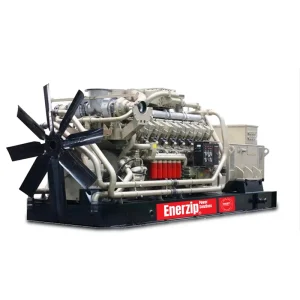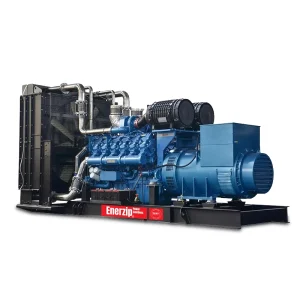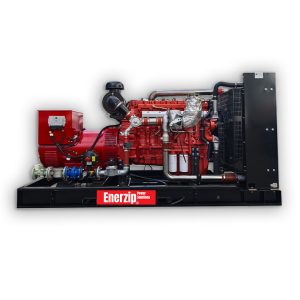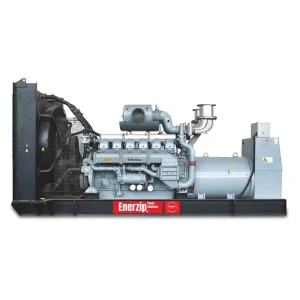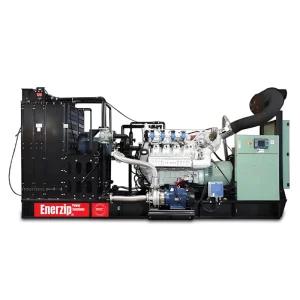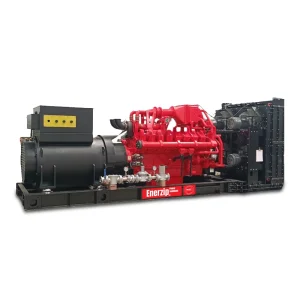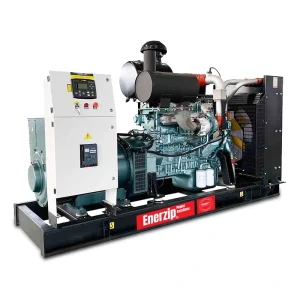

Enerzip natural gas generator sets provide reliable and economical on-site power for standby backup, prime operation, and continuous duty using pipeline natural gas. We manufacture a complete portfolio covering 20–5000 kVA, including C, E, D, MA, P, W, and J Series platforms, serving industrial, commercial, oilfield, and CHP projects.
Features:
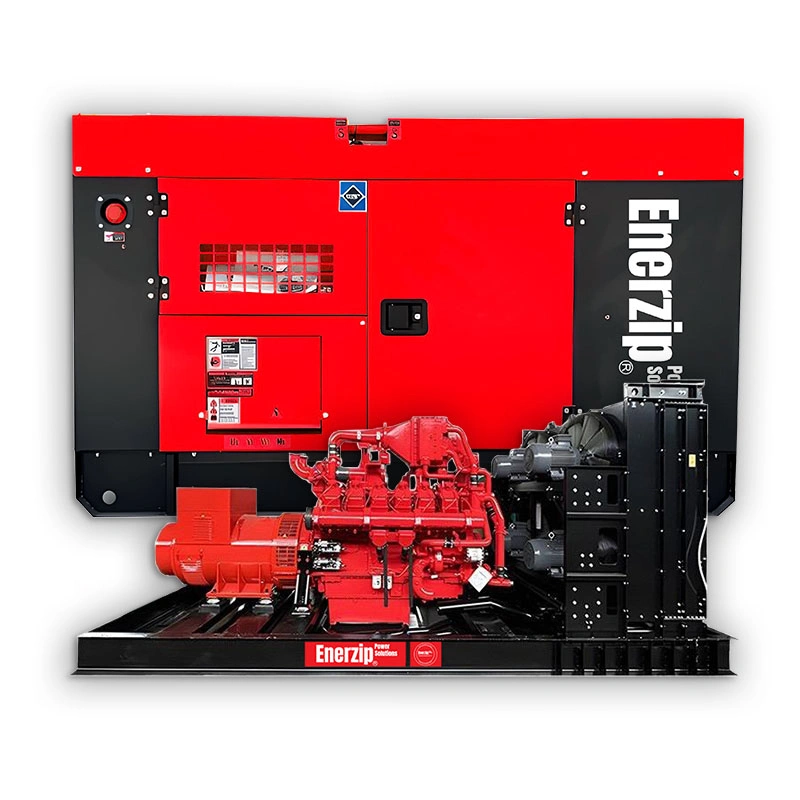
Enerzip’s natural gas generator portfolio spans 20–5000 kVA and is organized around how projects actually operate. E Series (20–313 kVA) is built for small to medium users who prioritize affordability and simple maintenance, while D Series (143–376 kVA) targets mid-range industrial users requiring stronger transient response and durable diesel-based structure. For high-efficiency CHP and premium continuous power, MA Series (55–715 kVA) (MAN Germany) is engineered to maximize electrical and thermal efficiency. For large industrial baseload with maintainability advantages, P Series (375–1238 kVA) (Perkins 4000) delivers lean-burn efficiency and 24/7 reliability. For ROI-driven industrial projects with broad coverage, W Series (38–1750 kVA) (Weichai + Baudouin tech) provides rugged value and scalable capacity. For multi-megawatt oilfield and captive power plants, J Series (625–5000 kVA) (CNPC Jichai) is optimized for associated gas utilization and power-station-level integration.
Instead of using a “one-size-fits-all” gas genset approach, Enerzip recommends the proper series and configuration based on duty cycle, load profile (including load steps), site environment (ambient/altitude/enclosure), and fuel gas conditions—helping reduce common project risks such as under-sizing, unstable voltage/frequency under transient loads, excessive OPEX, high-ambient overheating, and integration mismatch (ATS/paralleling/grid).
50/60Hz and common voltages (e.g., 400/480V) are available, with optional 3.3–11kV output for HV projects. Delivery formats include open type (easy service for plant rooms), silent type (noise-sensitive sites), and containerized solutions (fast deployment for remote or harsh environments).
With standardized configurations and a mature supply chain, we support fast preparation and responsive quotation based on your required kVA, duty cycle, and site conditions.
Quality is our core promise. Each natural gas genset is built with system-grade integration and inspected for stable voltage/frequency, protection performance, gas train safety (leak-tightness and shut-off logic), and controller–ECU communication—supporting reliable long-hour operation and project-ready performance on site.
Our team is available 24/7 to assist with selection, installation, commissioning, and troubleshooting—covering ATS setup, paralleling/grid synchronization guidance, and fuel gas requirement checks—so you get dependable support throughout your project lifecycle.
Natural gas projects rarely run under “standard conditions”—duty cycle, load steps, site environment, and integration mode define the real engineering requirements. That’s why the right configuration is determined by how the project runs and how the loads behave, not by kVA alone.
In practice, natural gas power systems commonly face:
Operating mode differences: standby with ATS, prime power, and 24/7 continuous duty require different cooling margins, control logic, and maintenance planning.
Load steps & motor starting: pumps, compressors, and refrigeration can cause sudden load spikes. If the genset is not matched to transient performance, it may experience frequency dips, voltage instability, or nuisance trips.
Site conditions: high ambient temperature, altitude, limited ventilation, and enclosure airflow resistance can lead to overheating or derating if cooling is not sized correctly.
Fuel gas variability: pipeline gas is relatively stable, but projects using treated biogas, LNG vapor, or associated gas must confirm methane number, pressure stability, and contaminant limits to avoid abnormal combustion or protection shutdowns.
Integration complexity: ATS backup, multi-unit paralleling, and grid synchronization require different controllers, switchgear logic, protections, and commissioning scope.
To make selection faster and reduce mismatch, this category page follows a multi-series strategy aligned with common project types and duty cycles:
E Series – Natural Gas Generator Sets (20–313 kVA) — for small-medium users where affordability, simple maintenance, and quick deployment matter most.
Typical for restaurants, farms, workshops, small factories, and residential compounds.
D Series – Natural Gas Generator Sets (143–376 kVA) — for mid-range industrial sites requiring stronger transient response and diesel-based rigidity.
Typical for SMEs, cold storage, manufacturing, and cost-sensitive continuous duty.
MA Series – Natural Gas Generator Sets (55–715 kVA) — for CHP and premium continuous power where efficiency and heat recovery value drive ROI.
Typical for hotels/spas, hospitals, WWTP biogas-to-CHP, and high-precision manufacturing.
P Series – Natural Gas Generator Sets (375–1238 kVA) — for heavy-duty baseload with lean-burn efficiency and maintenance-friendly design.
Typical for industrial plants, IPP projects, large commercial complexes, and CCHP.
W Series – Natural Gas Generator Sets (38–1750 kVA) — for broad industrial coverage prioritizing fastest ROI and rugged value.
Typical for general industry, commercial real estate, emerging markets, and scalable capacity planning.
J Series – Natural Gas Generator Sets (625–5000 kVA) — for megawatt-class CPP and oilfield applications using associated/flare gas and power-station-level integration.
Typical for oil & gas fields, captive power plants, and multi-megawatt power stations.
For deeper planning and faster quotation, you may also explore: CHP (Combined Heat and Power) Solutions, ATS & Paralleling / Grid Synchronization, and Gas Conditioning & Fuel Requirements Guide (pressure regulation / moisture / impurities / methane number).
What we typically review to recommend the right series/configuration: required kVA/kW, duty cycle (standby/prime/continuous), operating mode (ATS / island / grid-parallel / multi-unit), load profile (motor starting and load steps), fuel gas type and pressure, site conditions (ambient temperature / altitude / enclosure requirement), and target ROI.
To recommend the right sizing and configuration, please share:
Fuel Gas: gas type (pipeline NG / LNG vapor / associated gas), inlet pressure range & stability, methane number (if available), moisture/impurities (if known).
Power: required kVA/kW, voltage & frequency (50/60Hz), running hours/day, load profile + largest motor starting details (if any).
Mode: standby/prime/continuous, ATS required or not, grid-parallel/paralleling plan (single or multi-unit, N+1 if needed).
Site: ambient temperature, altitude, delivery form (open/silent/container), ventilation/noise limits, CHP required or not.
Natural gas generator sets are commonly used where projects need dependable on-site power with predictable operating cost. Applications range from standby backup to prime/continuous duty and multi-unit plants, with options such as ATS integration, CHP heat recovery, grid synchronization, and paralleling (project dependent). Typical application fields include:
Commercial Buildings & Real Estate Backup
Standby power for hotels, malls, offices, and residential compounds—supporting essential loads such as elevators, HVAC, fire systems, and lighting. Typical focus: silent enclosure, ATS coordination, and stable voltage/frequency for mixed building loads.
General Manufacturing & Industrial Prime Power
Prime/continuous power for factories running pumps, compressors, refrigeration, and production lines—especially where grid supply is unstable or demand charges are high. Typical focus: load-step performance (motor starting), high-ambient cooling margin, and long-hour maintenance planning.
Oil & Gas Fields (Associated Gas Utilization)
On-site generation for worker camps, auxiliary drilling loads, and water injection pumps using treated associated/flare gas (within agreed fuel specifications). Typical focus: gas conditioning, pressure regulation, containerized deployment, and reliability in dust/high-temperature environments.
CHP / CCHP Energy Centers (Heat Recovery Projects)
For sites with stable thermal demand—e.g., hospitals, hotels/spas, process plants, and district energy—recovering jacket-water and exhaust heat to improve total efficiency and ROI (project dependent). Typical focus: heat-use matching, heat exchanger scope, and control strategy.
Data Centers & Telecom Backup (Entry to Industrial Level)
Backup or prime solutions for enterprise data centers, telecom hubs, and regional server rooms requiring stable electrical quality and redundancy planning. Typical focus: ATS/synchronizing logic, N+1 capacity design, and commissioning verification for critical loads.
Grid-Parallel & Multi-Unit Power Plants
IPP/captive plants and industrial parks using multi-unit paralleling for staged expansion, redundancy, and grid synchronization (project dependent). Typical focus: protection schemes, switchgear and controls integration, and compliance with local grid interconnection requirements.
Please confirm the required rating basis: Standby (ESP) for emergency use, Prime (PRP) for long-hour variable load operation, or Continuous (COP) for constant baseload. For correct sizing of an industrial natural gas generator (generator for industrial use), provide: total kW/kVA, power factor (if available), the largest motor load and starting method, and any step-load requirement. We will state the selected rating and operating assumptions clearly on the quotation.
Please specify 50Hz/60Hz, rated voltage (e.g., 400/230V or 480/277V), phase, wiring system (3P3W/3P4W), and whether a neutral is required. If medium-voltage output is required, confirm 3.3–11kV and interface requirements so the offer matches an industrial power generator package without later rework.
Please confirm whether the quotation is for genset-only or a packaged solution. For packaged scope, define the interface boundary for ATS, synchronizing/paralleling, protections, gas train boundary, exhaust interface, cable termination, and monitoring. This is essential for an automatic backup generator / industrial standby generator project to avoid missing items during delivery and commissioning.
Provide the fuel type (pipeline natural gas / LNG vapor / treated associated gas), inlet pressure range (min/normal/max), and whether the supply is regulated or fluctuating. If available, include gas temperature and upstream constraints. Clear gas-supply definition helps an industrial backup generator deliver stable combustion and predictable performance.
State the required delivery format: open type (indoor/easy service), silent type (noise-sensitive), or containerized (fast deployment/remote). Provide ambient temperature, altitude, available space, ventilation method, and any acoustic requirement. This ensures your industrial backup power solution is engineered for the real site, not just “standard conditions.”
Please specify whether FAT and/or SAT is required, and list deliverables such as nameplate data, wiring diagrams, GA drawings, O&M manuals, and commissioning checklist. If on-site support is needed, define scope and location. For buyers evaluating industrial generators for sale from a generator supplier / industrial generator manufacturers, clear acceptance criteria is the fastest way to control quality, schedule, and risk.