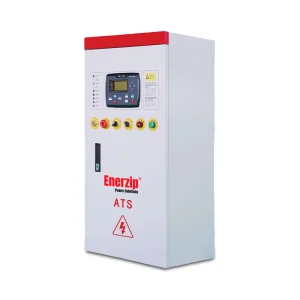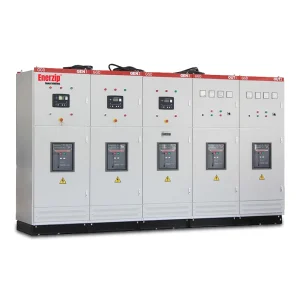

Enerzip Genset Control & Distribution solutions provide the control, switching, and low-voltage distribution layer that makes generator-based power systems safe, stable, and scalable. From Automatic Transfer Switches (ATS) for standby power to Paralleling & Grid-Connect Systems for multi-genset plants, Enerzip supports industrial and commercial projects where protection integrity, switching safety, and power management reliability matter as much as kW/kVA.
Features:
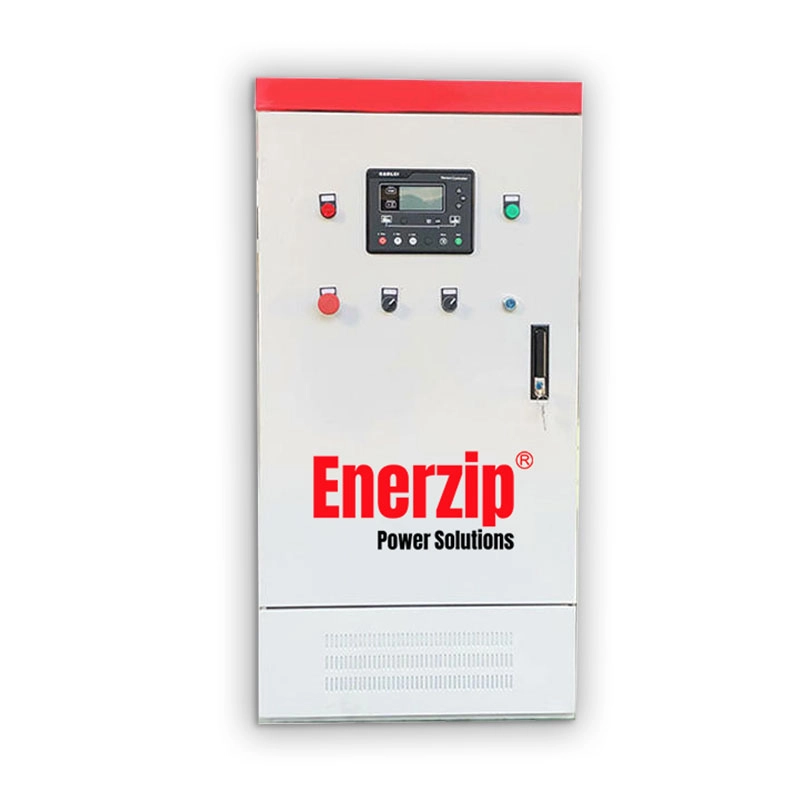
Enerzip’s Genset Control & Distribution portfolio is organized around how sites actually operate—safe source transfer for standby systems, and synchronization + power management for multi-unit plants.
ATSE Series focuses on fast, reliable dual-power transfer between utility and a standby source (e.g., diesel generator sets), compliant with IEC 60947-6-1 / GB 14048.11, covering 80A–3200A for commercial through heavy-duty industrial applications.
EZ-PGC Series focuses on intelligent paralleling and grid-connect control—synchronizing multiple diesel or gas generator sets, sharing kW/kVAr, managing breakers, and coordinating grid interaction. It supports up to 32 generator sets with modular project-specific design and compliance-oriented LV distribution engineering (e.g., IEC 61439 / GB/T 7251, with anti-islanding protection in grid-parallel projects).
Instead of a “one-panel-fits-all” approach, Enerzip recommends the proper control and distribution configuration based on operating mode (ATS standby vs. multi-unit plant), protection requirements, switching strategy, and interface scope (breakers, busbars, monitoring, and site control systems).
Enerzip® Genset Control & Distribution covers ATSE Series ATS (80A–3200A) and EZ-PGC Series paralleling & grid-connect systems (up to 32 gensets), with standard low-voltage switchgear integration, heavy-duty cabinets, and common monitoring interfaces for PLC/SCADA/BMS.
With standardized ATS current frames and modular paralleling architecture, we can quote quickly once you confirm single-line diagram (or topology), ATS rating, operating mode (standby/island/grid-parallel), and genset quantity—then build in a predictable lead time based on your cabinet scope and protection requirements.
Each system is verified at the functional level: source-transfer logic and interlocks (no unsafe parallel/backfeed), controller communication (DSE/ComAp/DEIF/SmartGen), breaker control and protections, I/O mapping, and alarm/status feedback—so commissioning on site is faster and safer.
We support selection and commissioning remotely, including ATS timing coordination with genset start, paralleling/synchronizing logic checks, and Modbus/RS485/Modbus TCP integration to PLC/SCADA/BMS—plus troubleshooting support during startup and operation.
Control & distribution projects are rarely “standard.” Real reliability is defined by switching strategy, protection integrity, breaker logic, load behavior, and interface scope—not by panel size alone.
In practice, generator power systems commonly face:
Operating mode differences: A simple standby ATS system is fundamentally different from a multi-unit plant with synchronizing/paralleling and grid interaction—logic, protections, and commissioning scope are not interchangeable.
Switching safety requirements: Backfeed prevention, no-parallel interlocking, and clear source position indication are critical in both commercial and industrial sites.
Load behavior & transients: Motor starting, step loads, and fluctuating demand require proper sequencing, kW/kVAr sharing, and stable voltage/frequency control at the plant level.
System growth & redundancy: Many sites need staged expansion and N+1/N+X concepts; paralleling systems must isolate faults and redistribute load without collapsing the bus.
Monitoring and coordination: Modern facilities often require integration with BMS / PLC / SCADA for alarms, status, and energy strategy.
To reduce mismatch, this category page follows a two-core-series strategy aligned with how generator sites operate:
ATSE Series – Automatic Transfer Switches (ATS) (80A–3200A) — for standby and emergency power where safe, fast source transfer is essential. Typical transfer time is ≤1s (model dependent), with adjustable delays for coordination with generators, UPS, and sensitive loads.
EZ-PGC Series – Paralleling & Grid-Connect Systems — for multi-genset power systems requiring synchronization (voltage/frequency/phase alignment), kW/kVAr load sharing, automatic start/stop sequencing for fuel optimization, redundancy/fault isolation, and grid-parallel operation where permitted. Typical start-to-breaker-closure can be ≤10s depending on engine/system conditions.
For deeper planning, you may also pair these solutions together: in many standby or grid-connected architectures, ATS source selection and paralleling control are coordinated to ensure safe switching and stable power delivery.
To recommend the right sizing and configuration, please share:
Power: required kW/kVA, voltage & frequency (50/60Hz), phase.
Mode: standby ATS / island / grid-parallel (where permitted) / peak shaving / base load / black start; N+1 if needed.
Gensets: quantity now + future expansion (up to 32), genset ratings, controller preference (DSE/ComAp/DEIF/SmartGen).
Loads: load profile + largest motor starting, sensitive loads (UPS/medical/IT), transfer constraints.
Enerzip® Genset Control & Distribution solutions are applied wherever projects require safe source transfer (ATS), multi-genset synchronization (Paralleling), grid connect/disconnect control (Grid-Connect), and system-level monitoring/integration (PLC/SCADA/BMS). Below are the most common, real-world application scenarios.
Typical Applications: office towers, hotels, shopping malls, mixed-use complexes, financial buildings.
Critical Loads: fire pumps, emergency lighting, elevators (emergency mode), access control/security, smoke exhaust systems, low-voltage/weak-current rooms, critical HVAC.
Engineering Focus: life-safety and fire compliance are the top priorities. Projects typically adopt Enerzip® ATSE Series ATS as the core source-selection device. Mechanical + electrical interlocking prevents unsafe paralleling and backfeed, while adjustable transfer/return delays coordinate with generator start sequencing to reduce switching impact and nuisance operations. For large buildings or phased expansion, paralleling systems can be added to enable bus segmentation and staged load restoration for improved long-term operability.
Typical Applications: data centers, server rooms, telecom hubs, network core facilities, IDC campuses.
Critical Loads: UPS input, precision cooling, servers/storage, network switches/routers, security and monitoring systems.
Engineering Focus: the requirement is not simply “transfer,” but controlled transfer with proven disturbance limits and maintainable redundancy. A typical architecture uses ATS for safe utility/generator source selection and an Enerzip® EZ-PGC Paralleling & Grid-Connect System to manage synchronization, kW/kVAr load sharing, and N+1 strategies. As load grows, gensets are sequenced on/off to avoid inefficient low-load operation (higher fuel burn and carbon buildup). If a unit develops a fault or alarm trend, the system isolates the affected genset and redistributes load to maintain a stable bus. Operationally, ATS status, breaker positions, online unit count, kW/kVAr, and alarms are often uploaded via RS485/Modbus/Modbus TCP to BMS/SCADA for centralized monitoring and event traceability.
Typical Applications: hospitals, emergency departments, operating theaters, laboratories, diagnostic centers, medical campuses.
Critical Loads: life-support systems, ICU equipment, surgical lighting, diagnostic devices, medical gas systems, critical HVAC, emergency and fire systems.
Engineering Focus: healthcare sites are life-safety environments with strict requirements on transfer strategy, interlocking logic, and status visibility. Projects prioritize reliable ATS transfer, clear source position indication and maintenance isolation (I/0/II positions with lockout options), and stable behavior during transfer and restoration. For multi-building campuses or zoned distribution, multi-genset paralleling supports bus segmentation and staged restoration to reduce single-point risk and improve planned maintenance feasibility.
Typical Applications: factories, production lines, chemical/process plants, utility plants and pumping stations, industrial parks.
Critical Loads: motors (pumps/fans/compressors), conveyors, welding/VFD systems, control panels, safety systems, key production lines.
Engineering Focus: industrial sites often face heavy motor starting, large load steps, and fluctuating demand—plus peak-demand cost pressure. For backup-only sites, ATS ensures safe transfer and interlocking. For sites needing both resilience and cost control, the paralleling and power management system can automatically start gensets during peak periods (peak shaving) and stop units when load drops, improving fuel efficiency and reducing mechanical wear. Engineering emphasis typically includes fault-level matching, breaker selection, protection settings, and interlocking logic to prevent mis-closing events or fault escalation that could lead to plant-wide outages.
Typical Applications: mines, drilling sites, camps, remote pumping stations, off-grid industrial locations.
Critical Loads: heavy equipment, pumping and compression systems, site infrastructure and safety loads, critical controls.
Engineering Focus: many remote sites operate permanently in Island Mode, with harsh conditions (heat, dust, vibration) and high transient load events. Multi-genset paralleling shares step loads across units to reduce frequency dips and voltage swings, while enabling modular expansion as demand grows. With N+1 logic and fault isolation, maintenance can be scheduled without shutting down the entire site. These projects also emphasize cabinet structural strength, busbar current capacity and thermal performance, and closed-loop remote monitoring/alarms for field operations.
Typical Applications: airports, metro systems, ports, municipal critical facilities, substations and auxiliary power systems.
Critical Loads: lighting, control systems, communications, safety and emergency systems, critical monitoring loads.
Engineering Focus: infrastructure sites require critical loads to remain online during grid disturbances, with switching that is compliant and auditable. ATS provides safe source transfer, while paralleling/grid-connect systems support multi-unit plant control and bus segmentation to reduce disturbance and operational errors. These projects commonly integrate with centralized SCADA/control rooms, requiring real-time visibility of source status, breaker positions, event logs, and critical feeder supply status for operations and compliance review.
Choose a standalone ATS when you have a single genset and need automatic utility-to-generator transfer for standby power. Choose ATS + paralleling/grid-connect when you need multiple gensets, N+1 redundancy, Island Mode microgrid, peak shaving/base-load, or grid-parallel operation (where permitted).
Provide voltage, phase, frequency (50/60 Hz), earthing system, and your target ATS rating. Include the site available fault level (kA) (or transformer size/impedance and upstream protection data) and any motor starting/step loads. If you have UPS ride-through limits or allowed interruption time, include them as well.
The EZ-PGC system can be engineered to support up to 32 gensets (project dependent). Expansion is typically possible if the original design reserves busbar capacity, breaker frames, control I/O, and communication ports—so include your current genset count and future expansion target in the RFQ.
Common options include RS485 (Modbus RTU) and Modbus TCP/IP, with CAN used where required by the controller/system architecture. In your RFQ, specify the protocol, the points you need to monitor (source status, breaker positions, kW/kVAr, alarms), and whether you require remote control functions.
State whether grid-parallel operation is permitted locally and any utility interconnection requirements. Provide the interconnection point, available fault level, and required protections such as anti-islanding, reverse power/backfeed prevention, and synchronization checks. Also define the operating strategy (e.g., zero export, export limits, peak thresholds).
Ask for SLD, wiring diagrams, terminal lists, I/O mapping, communication register lists, and sequence/interlock logic. For verification, request FAT functional tests (ATS interlocks, breaker control, synchronization/load sharing, alarms, and communications) and define whether SAT/commissioning support is required (remote or on-site).