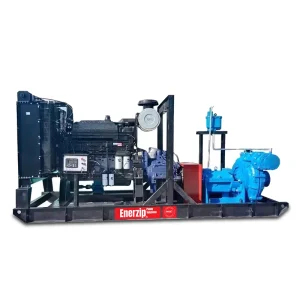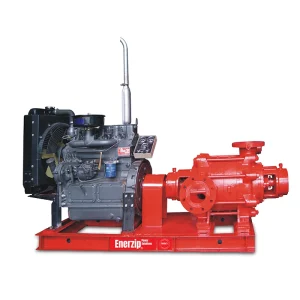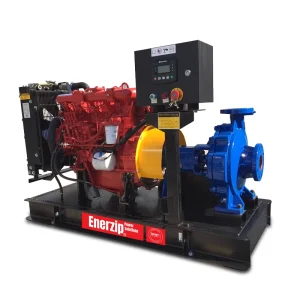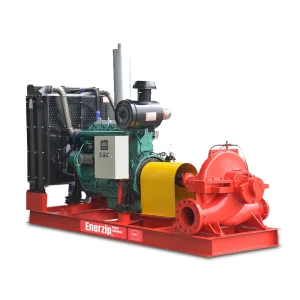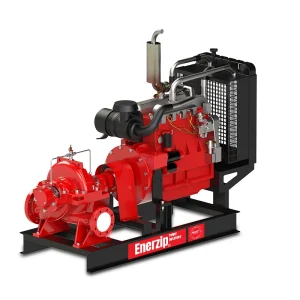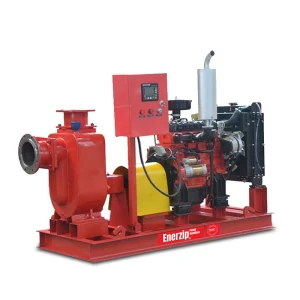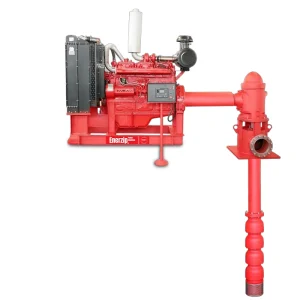

Diesel engine water pumps deliver reliable, grid-independent pumping when electricity is unavailable, unstable, or too costly to extend—especially for flood control, construction dewatering, irrigation, mine dewatering, industrial cooling, and emergency bypass work. Enerzip (Enerzip Power Technology (Weifang) Co., Ltd.) is a heavy-duty diesel engine water pumps manufacturer providing engine driven pumps engineered for real site constraints such as suction conditions, solids content, long-hour duty cycles, high ambient temperature, and fast field deployment—so flow and head performance stays predictable when uptime is non-negotiable.
Features:
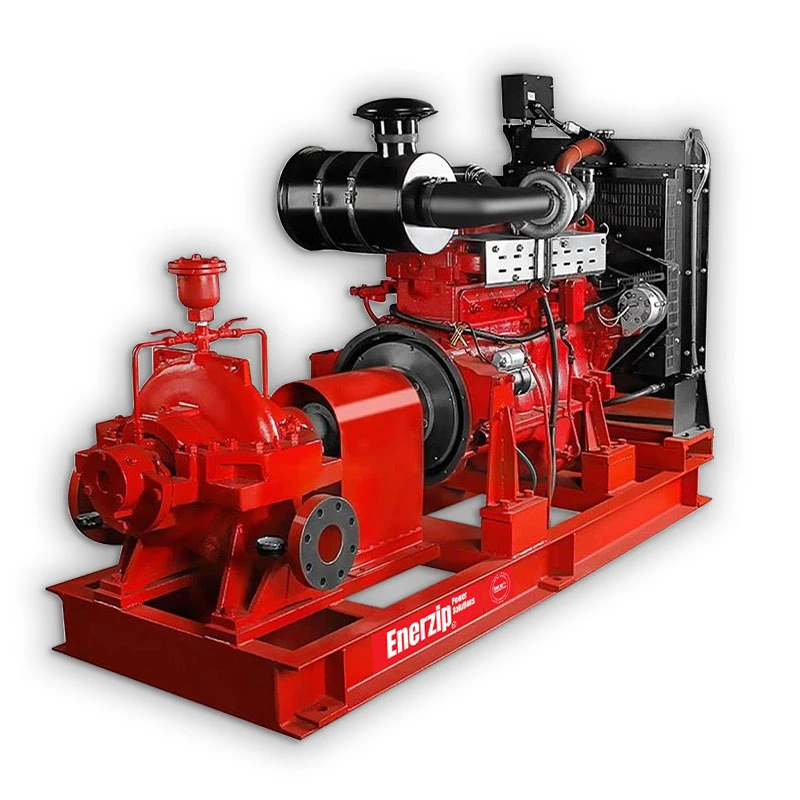
Enerzip’s diesel engine water pump portfolio is organized by how sites actually pump water—rapid-response dewatering, massive flow transfer, low-head flood discharge, ultra-high head boosting, abrasive slurry transport, and deep-well extraction. Instead of selecting by “inch size” alone, we help match the correct series based on duty point (flow/head), suction/NPSH reality, solids content, duty cycle, and deployment format, reducing common issues such as loss of prime, cavitation, clogging, overheating, and under-powered engine lugging.
Enerzip® diesel engine water pumps cover self priming, double suction, split case, mixed flow, multistage, slurry, and deep well/vertical turbine solutions—matching real jobs from emergency dewatering to long-hour transfer and high-head boosting. Packages can be skid/trailer mounted (project dependent).
With repeatable series platforms and modular integration, we can quote quickly once you confirm duty point (flow/head), media, and installation scope. Lead time mainly depends on engine brand, skid/trailer piping, controls, and protection requirements.
Each pump set is checked at the system level for alignment, starting reliability, protection functions, and stable operation at the intended duty range (project dependent). For demanding sites, suction assumptions, vibration tendency, cooling margin, and safe-stop logic are also verified to reduce commissioning risk.
We support selection, installation guidance, commissioning coordination, and troubleshooting—covering duty-point verification, engine power reserve/service factor logic, and controller setup. Remote support is available for long-hour operation and field emergencies.
Diesel engine water pump projects rarely run under “standard conditions”—suction reality, solids content, duty cycle, and field deployment constraints define the real engineering requirements. That’s why the right diesel engine water pump configuration is selected by duty point and site conditions, not by pump size alone.
In practice, engine driven pumping systems commonly face:
Suction & priming uncertainty: variable water levels, air leaks, long suction hoses, re-prime events, and unstable intake conditions.
Duty-point mismatch: oversizing wastes fuel and causes unstable operation; undersizing leads to engine lugging, overheating, and low output.
Solids, debris & abrasives: clogging risk, wear rate, and performance drop for muddy floodwater, sewage bypass, or slurry transfer.
Harsh environments: high ambient temperature, dust, humidity, and long-hour operation that stress cooling and alignment.
Field deployment limits: fast setup, portability, maintenance access, and safe unattended operation (project dependent).
To make selection faster and reduce mismatch, this category page follows a 7-series strategy aligned with real pumping scenarios:
EZ-SP Series – Diesel Self Priming Pumps — for rapid deployment where external priming is impractical.
Typical for municipal drainage, construction dewatering, sewer bypass, and emergency response.
EZ-DS Series – Diesel Engine Double Suction Pumps — for large-volume transfer with stable long-hour operation.
Typical for municipal pumping, flood mitigation stations, irrigation districts, and industrial circulation.
EZ-SC Series – Diesel Engine Horizontal Split Case Pumps — for high-capacity transfer with split-case access and wide operating range.
Typical for long-distance transfer, industrial cooling, flood control, and fire backup.
EZ-MF Series – Diesel Drive Mixed Flow Pumps — for low-head, high-flow discharge where efficiency matters (typ. 3.9–14.3 m head range).
Typical for flood pumping, canal feeding, raw-water transfer, and large-scale irrigation.
EZ-MS Series – Diesel Engine Multistage Pumps — for ultra-high head / high pressure pumping (head up to 1922 m, model dependent).
Typical for mine dewatering boosters, municipal pressure boosting, RO/high-pressure cleaning, and mountainous transfer.
EZ-SL Series – Heavy-Duty Diesel Engine Slurry Pumps — for abrasive, high-solid slurry transfer with wear-resistant liners (Cr27 or rubber options, series dependent).
Typical for mineral processing, tailings, dredging/sand mining, FGD/ash handling, and sludge transfer.
EZ-DW Series – Diesel Engine Driven Deep Well / Vertical Turbine Pumps — for deep groundwater extraction and off-grid well supply (up to 1.2 MPa discharge pressure, system dependent).
Typical for irrigation wells, remote water supply, mine dewatering, and exploration sites.
System-first selection logic (what we typically match): pump duty point (flow/head), suction condition, media type (clear/muddy/slurry), duty cycle (intermittent vs 24/7), and diesel torque availability with an appropriate service factor (typ. SF ≥ 1.25). Final configuration may include skid-mounted packages, quick-connect layouts, monitoring/protection, and safe-stop logic (project dependent).
For deeper planning and faster quotation, you may also explore: Self-Priming vs Non-Priming Suction Guidance, Slurry Media & Wear Selection Notes, and Engine Matching & Service Factor Rules.
To avoid under- or over-engineering, we size the set based on your duty point (flow + TDH) and operating mode.
Duty point: flow (m³/h) + TDH (m), and whether it varies
Medium: clean / muddy / sewage / slurry (solids %, particle size, abrasiveness/corrosion)
Suction: suction lift, line length/diameter, water level variation (NPSH if known)
Operating mode: hours/day, 24/7 or emergency standby
Diesel-driven pump projects are used where grid power is unavailable, unstable, or operationally risky, and where pumping must remain reliable under real suction conditions, changing water levels, solids, and harsh environments. Below are the most common application fields—and the practical engineering focus for each scenario.
Typical scenarios: stormwater response, flooded tunnels/underpasses, subway entrances, low-lying districts, polder drainage, temporary flood stations.
Engineering focus: fast deployment, uncertain suction conditions, debris-laden water, long-hour continuous running in hot/humid weather, remote start/stop.
Recommended series logic:
Self Priming for rapid response and re-prime uncertainty
Mixed Flow for low-head, maximum throughput flood discharge
Split Case / Double Suction for permanent or semi-permanent high-volume stations
Typical scenarios: foundation pits, cofferdams, trench dewatering, sewer bypass, pipeline maintenance/rehabilitation, temporary bypass lines.
Engineering focus: portability (skid/trailer), quick-connect piping, frequent relocation, suction lift variation, dry-run risk, solids/strings in sewage bypass.
Recommended series logic:
Self Priming for bypass work and unstable water levels
Split Case when higher head and long-distance bypass is required
Add monitoring + safe-stop logic for unattended night shifts and remote sites
Typical scenarios: river intake, canal feeding, off-grid irrigation districts, remote farms, seasonal high-hour pumping.
Engineering focus: fuel efficiency per m³, stable long-hour operation, low-head large flow, dust/hot ambient, simple field serviceability.
Recommended series logic:
Mixed Flow for low-lift high-flow canal feeding and flood/irrigation discharge
Split Case / Double Suction for larger transfer networks and long-hour stability
Deep Well / Vertical Turbine where groundwater wells are the primary source
Typical scenarios: open pits, underground tunnels, remote pumping stations, harsh dust/vibration environments, emergency water removal after storms.
Engineering focus: rugged integration, high torque reserve, 24/7 duty, abrasion risk, long discharge lines, reliability under poor site conditions.
Recommended series logic:
Multistage for high head booster duty and extreme lift requirements
Split Case for large transfer with maintenance-first access
Slurry when solids content/abrasiveness is significant (ore fines, sand, tailings water)
Typical scenarios: refineries, power plants, steel mills, chemical/process plants, emergency cooling backup, utility water transfer.
Engineering focus: stable flow under load steps, long-hour reliability, higher head than drainage, fast maintenance access, integration with plant monitoring and alarms.
Recommended series logic:
Split Case / Double Suction for high-capacity circulation and critical utility water
Self Priming for emergency standby or temporary bypass of cooling lines
Controls/alarms can be integrated to PLC/SCADA/BMS where required (project dependent)
Typical scenarios: boreholes/tube wells, rural supply, exploration camps, desert irrigation wells, mine water supply wells.
Engineering focus: true off-grid independence, vertical shaft drive reliability, high discharge head, stable long-hour duty, surface-maintainable engine layout.
Recommended series logic:
Deep Well / Vertical Turbine for boreholes and deep groundwater abstraction
Multistage as an alternative when high head is needed but the source is not a deep borehole (site dependent)
Typical scenarios: tailings transport, dredging/sand mining, FGD/ash slurry, municipal/industrial sludge transfer.
Engineering focus: wear rate control, liner material selection (alloy vs rubber), low-speed high-torque drive, clogging prevention, realistic head expectations (slurry dependent).
Recommended series logic:
Slurry Pumps with wear-resistant liners for abrasive/high-solid duty
Include instrumentation and protection to reduce overload and blockage downtime (project dependent)
Please share the duty point (flow + total dynamic head), the liquid/solids details (clean/muddy/sewage/slurry, solids %, particle size, abrasiveness), suction conditions (suction lift, suction pipe/hose length & diameter, water level variation, NPSH if known), duty cycle (hours/day, 24/7 or emergency standby), and site limits (ambient temperature, altitude, dust/humidity, noise requirement). These inputs determine the pump series, engine reserve, cooling package, and protection scope.
We size the engine from maximum pump shaft power at the intended duty range, then apply a service factor (typically SF ≥ 1.25) and a reserve strategy based on the application (e.g., higher reserve for slurry, long suction lines, difficult starting, or deep-well duty). This keeps torque stable during real conditions such as suction fluctuations, debris ingestion, density changes, and long-hour operation.
Choose a self priming pump when the site has unstable water levels, air ingress, frequent loss of prime, or when you need rapid setup without foot valves or vacuum assist—typical for emergency municipal drainage, construction dewatering, sewer bypass, and temporary pumping. If the water source is stable and priming is not an issue, a conventional centrifugal design may be more efficient at a fixed duty point.
It depends on the head and deployment reality:
Mixed flow pumps are usually the best choice for low-head, high-flow flood discharge (efficiency is strongest in low head ranges).
Self priming pumps fit rapid-response jobs with frequent reprime and uncertain suction conditions.
Split case / double suction pumps are preferred for long-hour, high-volume stations where maintenance access and stability are priorities.
Send your expected head range + water level variation and we’ll recommend the best series.
Please specify solids concentration (by weight/volume if possible), particle size distribution (D50/Dmax), abrasiveness (sand/ore/ash/gypsum, etc.), and whether the slurry is corrosive. Also confirm the required throughput and pipeline length if any. These determine liner material (high-chrome alloy vs rubber), speed strategy, expected wear rate, and the necessary torque reserve and protection settings to reduce clogging and overload trips.
Standard protections include low oil pressure, high coolant temperature, overspeed, and charging/starting alarms. For pumping-specific protection, we commonly recommend pressure-based or level-based start/stop (project dependent), dry-run / loss-of-suction protection where applicable, and remote alarm outputs (e.g., for PLC/SCADA/BMS). Safe-stop logic is important to prevent damage during abnormal suction, blockage, overheating, or overpressure events.